Is there anything more stressful than hearing that sickening crunch when you try to force a stuck window open? Or maybe you’ve just noticed that milky, foggy haze creeping up the glass, ruining your view of the Arizona sunset. You know something is wrong, but the idea of calling in a pro feels like opening a can of worms—you’re just waiting for the upsell, right?
Wait, Do I Really Need a Whole New Window?
Honestly, this is the first thing that goes through everyone’s head. You see a crack or feel a draft, and immediately you’re picturing a massive construction crew tearing out your drywall. But here’s the thing: most of the time, you don’t need a full replacement.
Window repair is a lot like car repair. Just because your tires are bald doesn’t mean you throw away the whole car. You just replace the tires. Windows are built in components—sashes, glass units (IGUs), balancers, rollers—and usually, only one of those things has failed.
Especially here in Maricopa County, the heat is a bully. It dries out seals and warps vinyl faster than in other parts of the country. So, when we talk about “repair,” we are usually talking about surgical strikes—fixing the specific part that the desert sun destroyed, without ripping out the entire frame.
Step 1: The “Doctor” Arrives (But With a Tape Measure)
When you finally bite the bullet and call us, the first step is the assessment. We aren’t just coming out to nod and say, “Yep, it’s broken.” We’re playing detective.
You might think a window is just a sheet of glass, but it’s actually a pretty complex little machine. When a technician arrives, they’re looking for the root cause.
- Is the glass foggy? That means the seal failed, and moisture got between the panes.
- Is it hard to slide? Your rollers might be flat-spotted or full of that lovely Arizona dust.
- Did it slam shut on its own? The balancers (the springs inside the frame) have probably snapped.
We’ll measure everything down to the sixteenth of an inch. And I mean everything. Glass thickness, the spacer bar width, the tint color. Because if we order a piece of glass that’s even slightly off, it’s not going to fit. It’s annoying for us, and it’s a waste of time for you.
The Glass Order: The Waiting Game
Here is the part that surprises people. Unless it’s a simple hardware fix—like swapping out a lock or a handle—we usually can’t fix it on the very first visit.
Why? Because almost no Residential Glass is “off the shelf.” It’s all custom.
If you have a dual-pane window (which you definitely should in this climate), that unit has to be manufactured. It involves cutting two pieces of glass, tempering them if they are near a door or floor, applying the Low-E coating to keep out the UV rays, and sealing them together with argon gas inside.
It’s a process. It usually takes a few days to a couple of weeks depending on the specs. I know, waiting is the worst. But trust me, you don’t want rushed glass. Poorly sealed glass will just fog up again after one heavy monsoon season.
Step 2: The Return Visit (Installation Day)
Okay, the parts are in. The technician is back. Now, what actually happens?
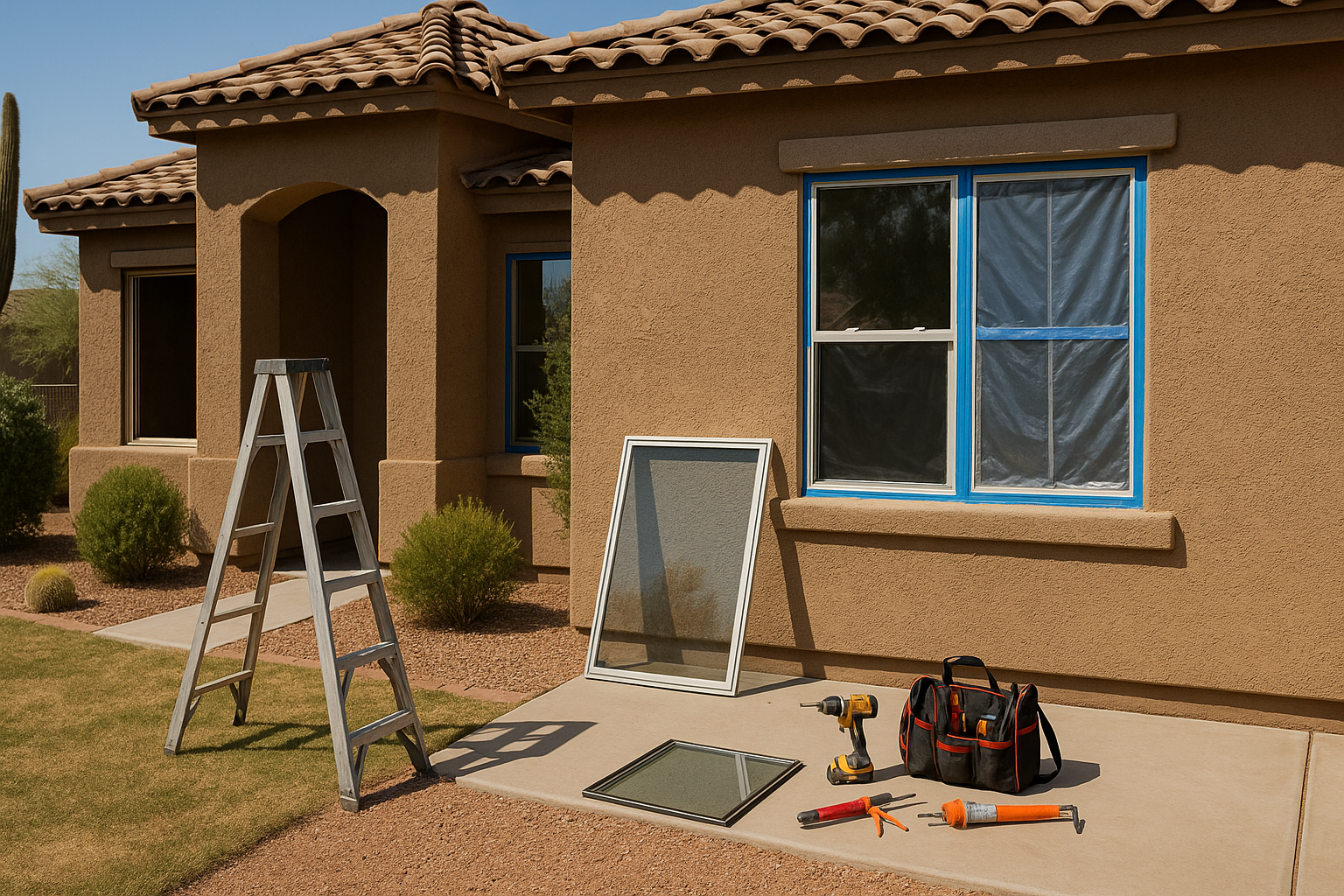
If we are replacing the glass, you don’t need to worry about a mess of shattered shards on your carpet. We treat your home like a sterile field. Drop cloths go down immediately.
The De-Glazing Process
This sounds fancy, but it’s basically just taking the window apart.
- The Bead: We pop out the “glazing bead”—those thin strips of vinyl or aluminum that hold the glass in place.
- The Cut: We cut the old adhesive tape or silicone that bonds the glass to the frame.
- The Swap: Out comes the old, failed unit. We clean the frame—scrubbing off the old gunk is satisfying, in a weird way—and prep it for the new glass.
It’s surprisingly quiet. Aside from the occasional drill noise or the thwack of a rubber mallet, it’s not a disruptive process. You can totally stay on a Zoom call in the next room.
It Might Just Be the Hardware
Sometimes, the glass is fine. It’s the mechanical stuff that’s given up the ghost.
You know how sliding patio doors in Phoenix get incredibly heavy over time? It feels like you’re dragging a bag of concrete every time you let the dog out. That’s usually just the rollers.
In this case, the repair is physically harder for us but faster for you. We have to lift the heavy door sash out of the track (and these things can weigh 100 pounds easily), flip it over, and gouge out the old, rusted rollers.
A quick side note on rollers:
Most builder-grade rollers are plastic. In our heat? They don’t stand a chance. We usually upgrade them to steel or precision bearing rollers. The difference is instant. You push the door with one finger and it practically glides across the room. It’s one of those “I should have done this years ago” moments.
Step 3: The Clean Up and “The Test”
We never just leave after the screw is tightened. We have to test it. Open, close, lock, unlock. Does it seal tight? Does it rattle?
If we replaced the glass, we’re cleaning it inside and out. There is nothing worse than paying for new glass and seeing a technician’s greasy thumbprint right in the center of it.
We also take the old glass and trash with us. You shouldn’t have to deal with disposing of a shattered window unit. That’s on us.
A Quick Word on “Foggy” Windows
I want to circle back to the foggy glass thing because it’s the number one question we get at Arizona Window Company.
People ask, “Can’t you just clean the fog off inside?”
Sadly, no. That fog is actually mineral deposits etched into the glass surfaces inside the sealed unit. Once a seal fails, the game is over for that piece of glass. The moisture gets in, the water evaporates when the sun hits it, but the minerals stay behind. It’s like a tiny, sad greenhouse. The only fix is a new Insulated Glass Unit (IGU).
But the good news? It’s cheaper than you think. You aren’t paying for a new frame, just the glass insert.
So, What’s the Verdict?
Repairing your windows isn’t nearly as scary or expensive as the industry sometimes makes it seem. It’s maintenance. Just like changing the oil in your car or flushing your water heater.
Living in the Valley means our homes take a beating from the elements. Windows are your first line of defense against those 115-degree days. When they work right, your AC bill goes down, and your house is quieter. When they don’t… well, you know the drill.
Don’t let a stuck sash or a cracked pane stress you out. It’s usually a straightforward fix that gets your home feeling comfortable again in no time.
Ready to get that window fixed?
We’re here to help you figure it out without the high-pressure sales tactics.
Give Arizona Window Company a call at 480-526-4456
or Request a Free Quote today.