Living in the Valley means having a complicated relationship with the sun—we love the winters, but by mid-July, that bright ball in the sky feels a lot less like a friend and more like a bully. You’ve probably walked past a window in your own house during the afternoon and felt that wave of heat radiating off the glass, almost like an oven door left slightly ajar.
Ideally, Your Windows Shouldn’t Need a Sweater
Here’s the thing: nobody likes paying SRP or APS more than they absolutely have to. When summer hits Maricopa County, your air conditioner is essentially running a marathon every single day. If your windows are old single-pane glass or aluminum frames from the 80s, your AC isn’t just running a marathon; it’s running it with a backpack full of rocks.
Choosing energy-efficient glass isn’t just about being “green” or saving the polar bears—though that’s nice, too. Honestly? It’s about being comfortable in your living room without having to crank the thermostat down to 68 degrees just to stop sweating. It’s about not having your nice leather couch fade into a weird shade of beige because the UV rays are relentless.
You might be thinking, “Glass is glass, right? It’s clear and it breaks.” Well, not exactly. Modern glass technology has moved so fast in the last decade that replacing your windows now is like trading in a flip phone for a smartphone. The difference in performance is wild.
Deciphering the Alphabet Soup on the Sticker
When you start shopping for replacement windows, you’re going to see a sticker on the glass. It’s the NFRC label. It looks a bit like the nutrition facts on a cereal box, but instead of calories and sugar, you’ve got terms like U-Factor and SHGC.
It can be confusing. Actually, it can be downright boring if you don’t know what you’re looking for. But stick with me, because two of these numbers determine whether your master bedroom stays cool or turns into a sauna.
The Big Two for Arizona
Here is a quick breakdown of what matters here in the desert versus what matters in, say, Wisconsin.
| Term | What It Means | Why It Matters in AZ |
|---|---|---|
| U-Factor | How well the window keeps heat inside. | Important, but secondary. We rarely worry about freezing to death here. A lower number is better (usually between 0.20 – 0.30). |
| SHGC | Solar Heat Gain Coefficient. How much solar heat gets through. | Crucial. This is the big one. You want this number as low as possible to block the sun’s heat. |
In Maricopa County, the SHGC is your best friend. It measures how much solar radiation passes through the glass and warms up your home. You want a low number. If a salesperson tries to sell you a high SHGC window because it’s “great for natural heating,” they probably think you live in Flagstaff. You want to block that heat, not invite it in for dinner.
Let’s Talk About Low-E (It’s Not Tint)
There’s a common misconception that to block heat, you need dark, tinted windows that make your house look like a limousine. You know what I’m talking about—those bronze or gray tints that make it look gloomy inside even when it’s noon.
That’s old school.
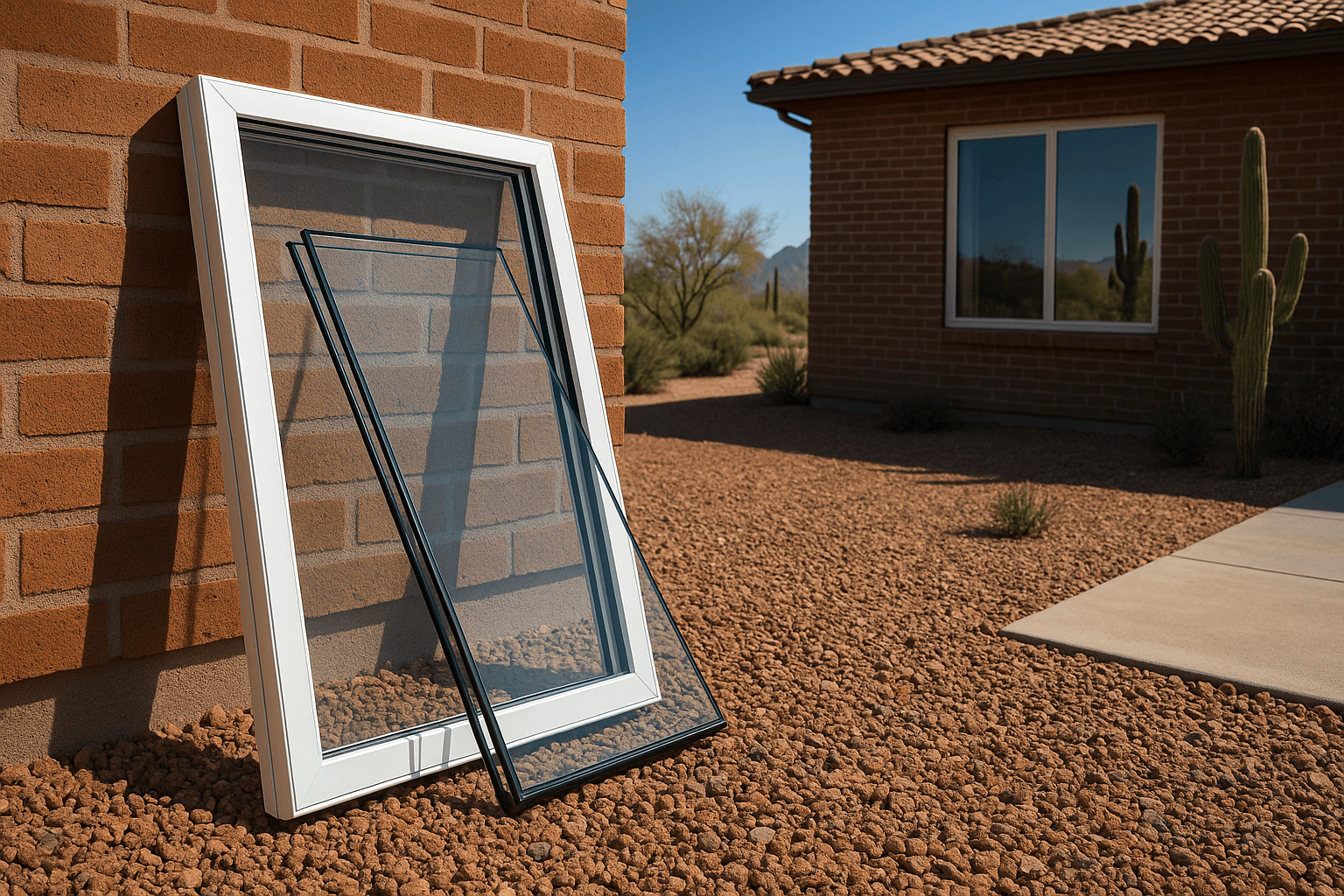
Nowadays, we use Low-E glass. Low-E stands for Low Emissivity. It sounds like intense science talk, but basically, it’s a microscopic layer of silver (yes, actual silver) or other metals applied to the glass. This coating is so thin you can barely see it, but it acts like a bouncer at a club.
It lets the visible light in—so your room is bright and happy—but it kicks the UV rays and infrared heat to the curb.
Here is a strange but true fact: Standard clear glass allows a massive amount of heat to pass right through. But high-performance Low-E glass reflects that heat back outside. It’s like putting sunglasses on your house, but without darkening the view. For us in Arizona, getting a “Low-E 366” or a triple-coat silver formulation is usually the gold standard. It creates a thermal barrier that is surprisingly effective.
The Gas Station Between the Panes
So, you have two pieces of glass. What goes in the middle?
If you said “air,” you’re technically right for older windows. But air is active. It moves around. It transfers heat.
To really slow down the heat transfer, manufacturers fill that space with inert gas, usually Argon. Argon is denser than the atmosphere we breathe. Imagine trying to run through water versus running through air; it’s harder to move through water, right? Heat has a harder time moving through Argon than it does through regular air.
There’s also Krypton gas, which is even denser than Argon. It’s fantastic, but it’s also significantly more expensive. For most homeowners in the Phoenix area, Argon offers the best bang for your buck. It boosts the insulation value significantly without doubling the price of the project.
Does the gas leak out? Over a very, very long time—we’re talking decades—maybe a tiny bit. But modern spacers (the seal between the glass panes) are incredibly tough. They are built to withstand the expansion and contraction that happens when our temperatures swing from 110°F in the day to 85°F at night.
Don’t Forget the Frame
We’ve been talking a lot about glass, but the frame is the chassis holding it all together. You can have the best glass in the world, but if you put it in a frame that conducts heat, you’re defeating the purpose.
In the old days, aluminum frames were everywhere in Arizona. They are durable, sure. But touch an aluminum frame at 3 PM in August. It’ll burn your fingerprints off. Aluminum is a conductor; it takes the outside heat and radiates it right into your drywall.
Most folks now look toward Vinyl or Composite frames. High-quality vinyl contains titanium dioxide which helps it resist heat and UV damage so it doesn’t warp or turn yellow. Plus, vinyl doesn’t conduct heat. When you touch a vinyl frame on a hot day, it stays relatively neutral.
Fiberglass is another great option—it’s rigid and expands at the same rate as the glass—but it tends to be pricier.
Is It Worth the Investment?
Let’s be real for a second. Replacing windows isn’t cheap. It’s a major home improvement project. You might be looking at the quote and thinking, “I could buy a nice used car for this.”
But think about the monthly bleed. If your current windows are single-pane, you are essentially throwing money out the window (pun intended) every time the AC kicks on. The savings on your energy bill can be substantial—often 15% to 25% depending on how bad your old windows were.
Beyond the cash, there is the silence. That’s the hidden benefit people forget to mention.
Thick, dual-pane glass with Argon fill dampens sound. The neighbor’s barking dog? The traffic noise from the boulevard? It gets dialed way down. Your home feels more solid, more private. It’s a peacefulness you didn’t realize you were missing until you have it.
Plus, if you ever decide to sell, savvy buyers in Maricopa County check the windows immediately. They know what old aluminum frames mean for their electric bill. New, energy-efficient windows are a massive selling point.
Ready to Stop the Bake?
Choosing the right glass can feel technical, but it really boils down to keeping the bad heat out and the good light in. You don’t have to suffer through another scorching summer with hot spots in your living room and an AC unit that never cycles off.
At Arizona Window Company, we understand the desert climate because we live in it. We know exactly which glass packages tackle the Maricopa County sun best.
Let’s chat about getting your home comfortable again.
Give us a call at 480-526-4456
or
Request a Free Quote