
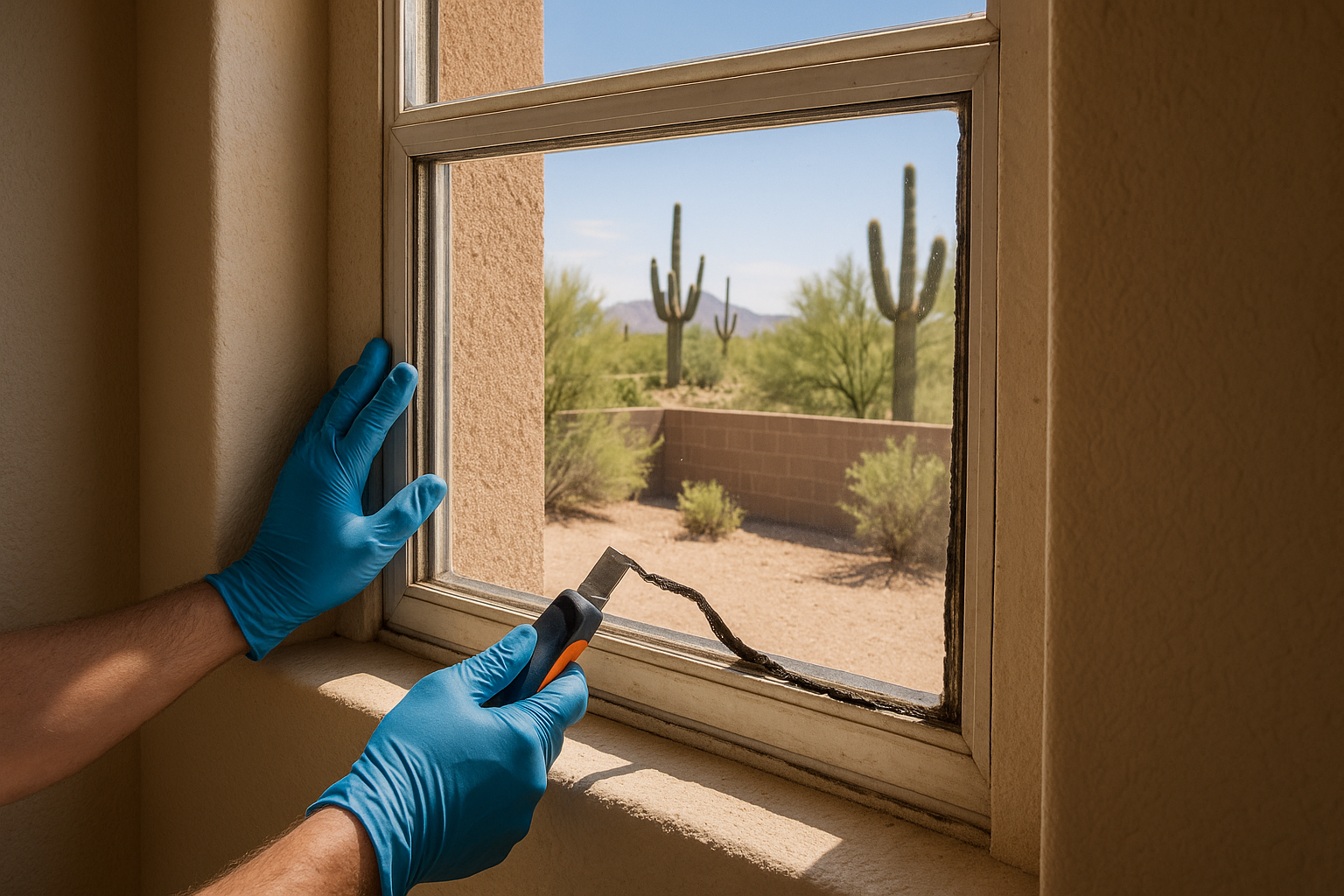
Living in Maricopa County means dealing with gorgeous sunsets, but honestly, it also means watching your AC bills skyrocket if your house isn’t buttoned up tight. If you’ve recently noticed a cloudy, milky film between your window panes that no amount of scrubbing can fix, you’re probably dealing with a blown window seal. Let me explain what’s actually happening behind the glass and how to handle it before the brutal summer heat really kicks in.
Wait, Are My Window Seals Actually Busted?
You know what? Most people don’t even think about their windows until something goes wrong. We just expect them to sit there, look pretty, and keep the Arizona dust outside where it belongs. But when a window seal fails, it’s basically an invisible leak in your home’s armor. It can be incredibly frustrating to look out at your backyard pool or the mountains, only to have your view ruined by a permanent smudge.
So, how do you know if your seals have actually failed? Here are the dead giveaways:
- The permanent fog: If you wipe the inside of the glass, then go outside and wipe the exterior, but the window still looks foggy? That moisture is trapped between the panes. The seal is toast.
- Weirdly warm drafts: Stand next to your window on a typical July afternoon. If you feel heat radiating heavily through one specific window but not the others, the insulating gas has probably leaked out.
- Dirt and dead bugs inside the glass: Yes, this happens. When a seal completely ruptures, monsoon winds can push micro-dust and tiny insects right between the panes.
- Distorted or warped reflections: Sometimes, a broken seal changes the pressure inside the window, causing the glass to bow inward or outward slightly. It looks like a mild funhouse mirror.
Honestly, that foggy look is the most common symptom. It usually starts small—maybe just a little haze in the bottom corner of the glass. Over time, that haze creeps upward until the whole window looks like it hasn’t been washed in a decade.
The “Science” of Double-Pane Windows (Explained Simply)
Here’s the thing. Modern windows aren’t just single sheets of cheap glass anymore. They are built as a complete system, which the industry calls an Insulated Glass Unit (IGU).
Think of your window like a heavy-duty thermos for your house. A thermos keeps your coffee hot by using two walls of metal with a vacuum space in between. An IGU works on the exact same principle. You have two panes of glass separated by a spacer bar. Inside that space, manufacturers pump in a heavy, invisible gas—usually argon or krypton. This gas slows down heat transfer, keeping the scorching desert heat outside and your expensive air conditioning inside.
But what happens when that seal eventually gives up?
Along the edges of the window, hiding behind the frame, is an Industrial sealant holding everything together. Inside the spacer bar, there is also a desiccant. If you’ve ever bought a new pair of shoes and found that little white packet of silica beads that says “Do Not Eat,” you already know what a desiccant is. It absorbs moisture.
For years, that desiccant silently absorbs any trace amounts of moisture that sneak past the seal. But eventually, the desiccant gets completely saturated. It just can’t hold any more water. Once that happens, the next time the temperature drops overnight, that excess moisture condenses directly onto the inside of the cold glass. Boom. Foggy windows.
Can You Actually Repair a Broken Seal?
Yes and no. Mostly no, but sort of yes.
I know that sounds confusing. Let me clarify. You cannot just take a caulk gun, squeeze some silicone around the edge of the glass, and call it a day. Once the factory seal is broken, the argon gas escapes into the atmosphere. You can’t put the gas back in, and you can’t restore the window to its original energy efficiency without professional help.
However, you do have a few options to fix the problem, depending on your budget and how badly the window is damaged.
Quick Comparison: Your Repair Options
| The Method | How It Works | Restores Insulation? | Long-Term Reliability |
|---|---|---|---|
| Defogging | Drilling a tiny hole, cleaning the inside, and adding a vent. | No. The argon gas is still gone forever. | Low. The fog often returns. |
| IGU Replacement | Swapping out just the glass panes and keeping your existing frame. | Yes. You get a brand new factory-sealed glass unit. | High. It is a permanent fix. |
| Full Replacement | Tearing out the old frame and glass, installing a completely new window. | Yes. Maximizes efficiency and updates the home’s look. | Highest. Comes with new warranties. |
A lot of folks ask us about defogging. It is definitely the cheapest route, but honestly, it’s just a cosmetic band-aid. Defogging makes the window look clear again by washing away the condensation, but your window still won’t insulate your home properly. When the Maricopa County sun is beating down at 115 degrees, you need that insulation. Replacing the IGU (just the glass part) is usually the sweet spot for homeowners. It gives you a brand-new, argon-filled glass unit without the massive expense of ripping your walls apart to replace the entire window frame.
DIY Fixes That Honestly Just Don’t Work
If you spend five minutes on YouTube, you will find someone claiming they fixed their blown window seals with a hairdryer and a drill. Just don’t do it.
People think they can drill a tiny hole in the corner of the glass, aim a hot hairdryer into the gap to evaporate the moisture, and then plug the hole with clear nail polish. That sounds clever, right? But it’s actually a complete disaster waiting to happen.
First off, drilling into tempered or annealed glass without professional tools usually results in a shattered window. I have seen homeowners turn a mild annoyance into a full-blown emergency because they accidentally spider-webbed their entire living room window. Second, even if you manage to dry out the inside, the moisture will come back. You haven’t fixed the broken seal; you’ve just given the moisture a brand-new entry point.
Window seals are hermetically applied at the factory under strict conditions. It’s highly specialized work. Trying to recreate that seal in your driveway on a Tuesday afternoon is just going to leave you frustrated.
Why the Arizona Desert is a Window’s Worst Enemy
You might be wondering why your seals failed in the first place. Did you buy a defective window? Probably not. The harsh reality is that Maricopa County is just brutal on building materials.
We deal with a phenomenon called “thermal pumping.” During a typical summer day, the direct sunlight hits your window, and the glass heats up dramatically. The argon gas inside the window expands as it gets hot, physically pushing the panes of glass outward. It actually balloons a tiny bit. Then, the sun goes down, the temperature drops, and the gas cools and contracts. The glass gets sucked back inward.
Expand. Contract. Expand. Contract.
Your windows do this every single day. They are literally breathing. Over a period of 10 or 15 years, this constant pulling and pushing wears out the flexible seal around the edge of the glass. Throw in the intense UV rays that bake the rubber components, and the gritty dust storms that wear away at the exterior caulking, and it’s no surprise that window seals eventually fail here. We love the desert, but it definitely takes a toll on our homes.
Let’s Get Your View Back
Living with foggy, inefficient windows isn’t just an eyesore; it’s quietly draining your wallet every time your air conditioner kicks on. You deserve to look out your windows and actually see the beautiful Arizona landscape, not a murky, condensation-filled mess.
If you suspect your window seals have thrown in the towel, we are here to help you figure out the most cost-effective solution. At Arizona Window Company, we know exactly what it takes to protect your home from the desert climate. We can inspect your glass, walk you through your options without any high-pressure sales tactics, and get your home sealed up tight again.
Don’t let the summer heat catch you off guard. Give us a call today by phone # 480-526-4456, or Request a Free Quote on our website to get started. Let’s get those windows crystal clear again!