
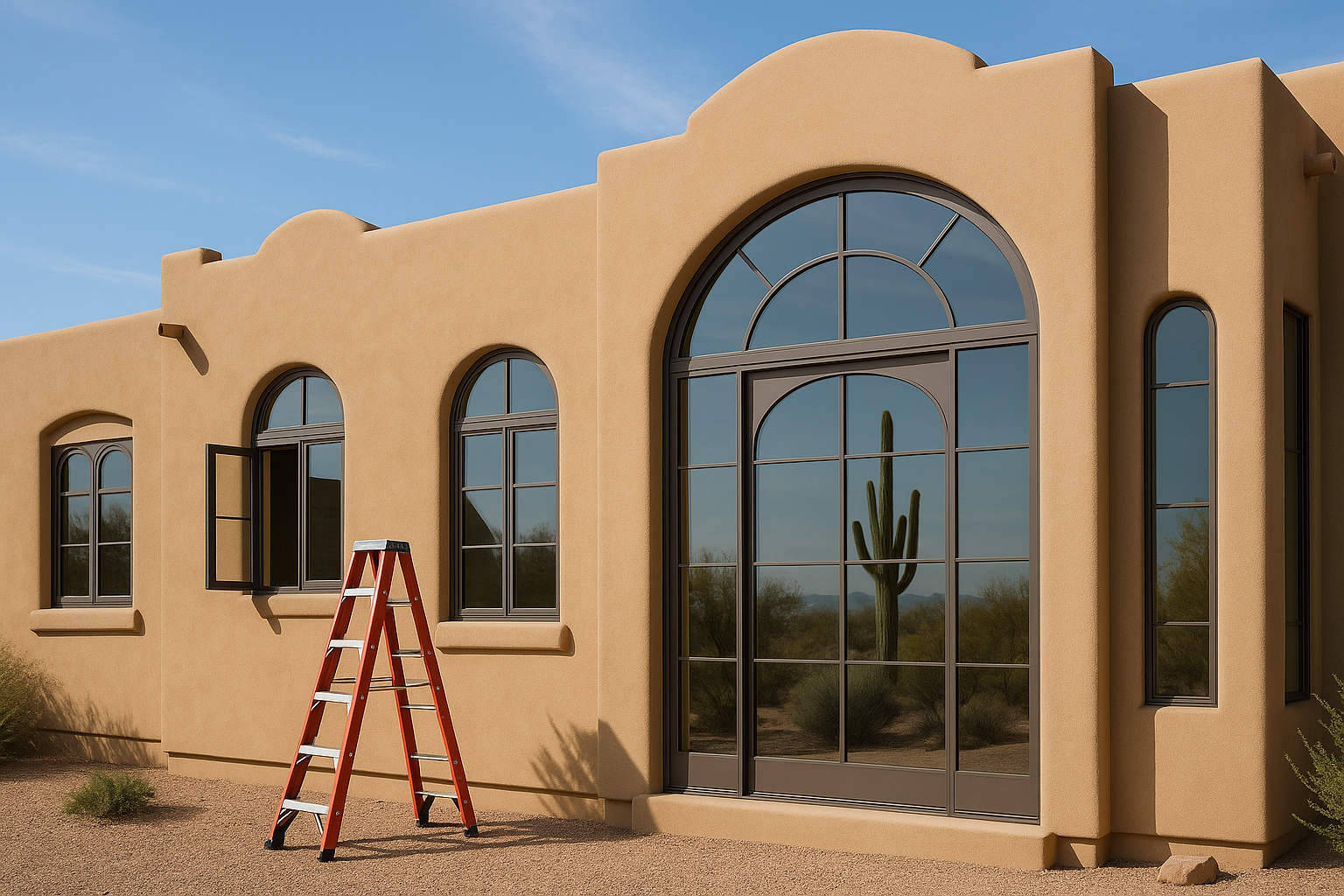
There is something undeniably special about walking into a room bathed in natural light, framed perfectly by a window that looks like it belongs in an art Gallery rather than a hardware store catalog. But let’s be honest for a second—when that stunning, custom-shaped window cracks or the seal fails, the panic sets in pretty quickly. You aren’t just looking at a simple repair; you’re looking at a puzzle that most standard repair kits just can’t solve.
So, You Have a Window That Isn’t a Rectangle?
Here in the Valley, we love our architecture. From those sweeping Santa Fe style arches to the sharp, angular lines of mid-century modern homes in Scottsdale, Maricopa County is full of glass that refuses to be boring. But here’s the thing: boring windows are easy to fix. You pop down to the big box store, grab a standard sash, and you’re done before lunch.
But you? You’re likely dealing with a trapezoid, a circle top, or maybe a massive clerestory window that sits so high up it collects dust you didn’t even know existed.
When these unique designs run into trouble—whether it’s a stress crack from our brutal summer heat shifts or a mechanism that just gave up the ghost—the solution isn’t straightforward. Standard glaziers might scratch their heads. You might even have a contractor tell you that you need to rip the whole wall apart to replace the frame.
Don’t panic. That’s usually not true.
The “Standard Fix” Trap
You know what? I’ve seen too many homeowners try to DIY a fix on a custom window, and it almost always ends in heartbreak (and a lighter wallet).
The problem is that custom windows often rely on proprietary hardware or specific glazing techniques that fell out of fashion ten or twenty years ago. If you have a custom timber-frame window or a specialized aluminum shape, the “universal” parts you buy online are going to fit about as well as a square peg in a round hole. Literally.
For unique designs, we have to look at retrofitting and custom fabrication.
- Custom Glass Cutting: We can’t just pull a sheet off the shelf. We often have to create a physical template—a pattern made of wood or heavy cardstock—to match the exact curvature or angle of your existing frame.
- Hardware Matching: Sometimes, the manufacturer who made your window in 1998 doesn’t exist anymore. In those cases, we have to source “new old stock” or modify modern hardware to work with vintage casements or awnings.
- Seal Integrity: Odd shapes have odd stress points. A standard seal might hold on a square, but on a triangle? The corners are weak points. We use high-grade structural silicone and specialized spacers to ensure the seal holds up against the Arizona sun.
Let’s Talk About the Heat (Because It’s Always About the Heat)
Living in Maricopa County means your house is essentially sitting inside a convection oven for four months out of the year.
Custom windows, especially the big, beautiful ones, are notorious for thermal stress. Think about it: glass expands when it gets hot and contracts when it cools down. If you have a huge arched window facing west, that glass is taking a beating.
When we repair these, we don’t just want to swap out the glass; we want to upgrade it. We’re talking about High-Performance Low-E (low emissivity) glass. It’s like putting premium sunglasses on your house. It reflects the heat back out while letting the light in.
If your custom window is foggy—you know, that milky look between the panes—that means your seal has failed. The insulating gas (usually Argon) has leaked out, and now moisture is getting in. For a custom shape, re-sealing is an art form. It requires precision to ensure the desiccant (the stuff that absorbs moisture) is hidden in the frame and not cluttering up your view.
Specific Headaches: Arches, Angles, and Operating Issues
Okay, let’s get into the nitty-gritty of what actually breaks. It’s not always the glass itself. Sometimes, it’s the moving parts.
The Stuck Casement
You have those beautiful crank-out windows, right? Maybe they are tall, narrow ones flanking a fireplace. Over time, the heavy glass makes the sash sag. The operator (the crank mechanism) strips out because you’ve had to force it shut for the last three years. Restoring these involves realigning the sash and replacing the operator with heavy-duty gearing that can handle the weight.
The Leaky Rake Window
These are those triangular windows that follow the roofline. They look amazing. But gravity is the enemy here. Water (during our aggressive monsoon storms) loves to find the bottom corner of a slanted window. If the “weep holes”—little drainage slots—are clogged or the flashing was done poorly, you get water on your drywall. Repairing this often means de-glazing the unit (taking the glass out), re-flashing the opening, and setting it back in with a marine-grade sealant.
Why Repair Instead of Replace?
Honestly? Money and mess.
Replacing a full window frame, especially a custom shape that is stuccoed into the side of your house, is a massive project. You’re talking about cutting back the exterior finish, potentially damaging the drywall inside, and dust—so much dust.
Custom repair is surgical. We aim to keep your original frame (which preserves the look of your home) and just fix what’s broken.
| Factor | Full Replacement | Custom Repair |
|---|---|---|
| Cost | High ($$$$) | Moderate ($$) |
| Time | Days or Weeks | Usually 1 Day |
| Mess | Major construction | Minimal disruption |
| Aesthetics | Might not match existing windows | Keeps original look |
There is a charm to maintaining the original integrity of a house. When we fix a vintage custom window, we aren’t just patching a hole; we’re preserving the character that made you buy the place to begin with.
A Quick Note on Glass Types
When we come out to look at a unique window, we check the glass type. Safety is huge here.
If you have a window near a door, or low to the ground (like a floor-to-ceiling picture window), it must be tempered glass. Tempered glass is heat-treated to be four times stronger than regular glass. If it breaks, it shatters into little pebbles instead of jagged shards.
For custom shapes, tempering is tricky because the glass has to be cut to size before it goes into the tempering oven. You can’t cut tempered glass; it explodes. That’s why measurements have to be exact. We measure twice, cut once, temper once, and install perfectly. It’s a process, but it’s the only safe way to do it.
Trusting the Process
Look, I get it. Calling a contractor is stressful. You’re worried about the cost, you’re worried about the mess, and you’re worried they’ll look at your weirdly shaped bathroom window and say, “Lady, I have no idea what that is.”
But at Arizona Window Company, weird windows are kind of our thing. We thrive on the challenging stuff. The stuff the other guys walk away from.
We treat your home like it’s our own. That means we show up when we say we will, we don’t leave glass shards in your carpet, and we explain exactly what we’re doing in plain English, not glazier gibberish.
Ready to Fix That View?
Don’t let a cracked pane or a stuck latch ruin the look of your unique home. Your custom windows deserve a custom solution, and we are right here in the neighborhood to make it happen.
Let’s get that window back to being the showstopper it was meant to be.
Contact Arizona Window Company today:
→ by phone # 480-526-4456
→ or Request a Free Quote