Living in Maricopa County comes with a very specific, undeniable reality: the heat is a physical force. You know that feeling when you open your front door in mid-July and it feels like you’ve just stuck your head inside a preheated oven? That’s our environment, and honestly, your house is fighting a daily battle against it.
Contents
Wait, Why Do My Windows Even Matter?
Here’s the thing about windows—they are essentially holes in your wall. Pretty holes that let in light and views, sure, but thermally speaking, they are the weakest link in your home’s armor. In the Arizona desert, we aren’t just dealing with “warm weather.” We are dealing with intense UV radiation, blowing dust, and temperature swings that can wreak havoc on building materials.
You might think, “Well, as long as the glass isn’t broken, I’m good.” But are you? If you’re running your AC nonstop just to keep the living room below 78 degrees, your windows are likely betraying you. It’s like trying to fill a bucket that has a slow leak at the bottom. You can keep pouring water (or pumping A/C) in, but you’re losing ground constantly.
The “Solar Heat Gain” Situation
Let’s get a little technical for a second, but I promise to keep it painless. In the window industry, we talk a lot about SHGC (Solar Heat Gain Coefficient). It sounds fancy, but it’s just a measurement of how much solar radiation passes through the glass and heats up your room.
In cooler climates, you actually want a high SHGC because free heat from the sun is nice when it’s freezing outside. But here? In Phoenix or Scottsdale? High solar gain is the enemy.
When the sun hits a standard, clear glass window, that radiant energy pours right in, heating up your carpet, your furniture, and the air itself. It’s why your cat loves sleeping in that sunbeam, but it’s also why your energy bill spikes in August. You need glass that acts like a bouncer at a club, letting the visible light in but telling the heat to stay out on the curb.
Frames: It’s Not Just About the Glass
People fixate on the glass—which makes sense, it’s the see-through part—but the frame material is arguably just as critical. In Maricopa County, materials expand and contract like crazy. We have days where it’s 115 degrees in the afternoon and drops to 85 at night. That thermal cycling puts massive stress on window frames.
Let’s look at the common contenders:
- Aluminum: Historically, this was the go-to in Arizona. It’s strong and cheap. But have you ever touched a metal slide on a playground in June? Ouch. Aluminum conducts heat, meaning it brings that outside temperature right into your home.
- Wood: It looks beautiful. Truly. But between the relentless sun drying it out and the potential for termites, wood requires a level of maintenance that most of us just don’t have time for.
- Vinyl: This is the most popular choice for a reason. High-quality vinyl has excellent insulating properties. However, you have to be careful. Cheap, builder-grade vinyl can warp or yellow under our UV index. You need a vinyl composition specifically engineered for high-heat environments.
- Composite/Fiberglass: These are the heavy hitters. They don’t expand or contract much, meaning the seals stay tight for decades.
You know what? There’s actually a funny misconception that metal frames are “tougher.” They might be rigid, but if they radiate heat like a radiator, they aren’t doing their job.
The Invisible Shield: Low-E Coatings
You’ve probably heard the term “Low-E” thrown around at Home Depot or in brochures. It stands for Low Emissivity. Basically, it’s a microscopic layer of silver or other metallic oxide sprayed onto the glass. You can’t really see it—maybe a slight tint if you squint—but it works wonders.
Think of it like a thermos. A thermos keeps hot coffee hot and cold water cold because it reflects the thermal energy back to where it came from. Low-E glass does the same thing. In the summer, it reflects the Arizona sun back outside. In the rare event we have a chilly winter night, it reflects your home’s heat back inside.
I remember talking to a homeowner in Mesa who was worried Low-E would make his house look dark, like wearing sunglasses indoors. Honestly, the technology has come so long way that you barely notice it anymore. The only thing you notice is that you can sit by the window without sweating.
Dealing with the Dust (and the Noise)
We can’t talk about Arizona weather without mentioning the dust. When a haboob rolls through, or even just on a breezy Tuesday, fine grit is trying to get into your house.
This is where the operation style of the window matters. Casement windows (the ones that crank out) generally have the tightest seal because the wind actually pushes the sash tighter against the frame. Sliding windows are great and very common here, but they rely on weatherstripping that needs to be kept clean.
And then there’s the noise. If you live near the 101 or a busy intersection, you know the drill. Single-pane windows block sound about as well as a sheet of paper. Switching to dual-pane (or even laminated glass) doesn’t just help with the heat; it turns the volume down on the outside world. Suddenly, your home feels like a sanctuary.
Installation: The “Secret Sauce”
You could buy the most expensive, triple-pane, krypton-gas-filled, aerospace-grade window on the planet. But if the guy installing it cuts corners, it’s basically garbage.
I’m serious. The installation is where the rubber meets the road. In our climate, the caulking and sealants used around the window frame have to withstand that brutal UV exposure we talked about earlier. If the sealant cracks after two years, you’ve got water leaks during monsoon season and air leaks all year round.
A bad install can also lead to “seal failure.” You’ve seen this before—windows that look foggy or have condensation trapped between the panes of glass. That means the seal broke, the insulating gas escaped, and moisture got in. Once that happens, the window’s insulating value plummets. It’s frustrating because the window looks structurally fine, but it’s ruined.
Is It Worth the Cost?
Let’s be real for a minute. Replacing windows is an investment. It’s not like buying a new toaster; it costs real money. So, is it worth it?
If you plan on staying in your home, the answer is almost always yes. The Department of Energy suggests that heat gain through windows is responsible for 25%–30% of residential heating and cooling energy use. In Arizona, I’d wager that number is on the higher end.
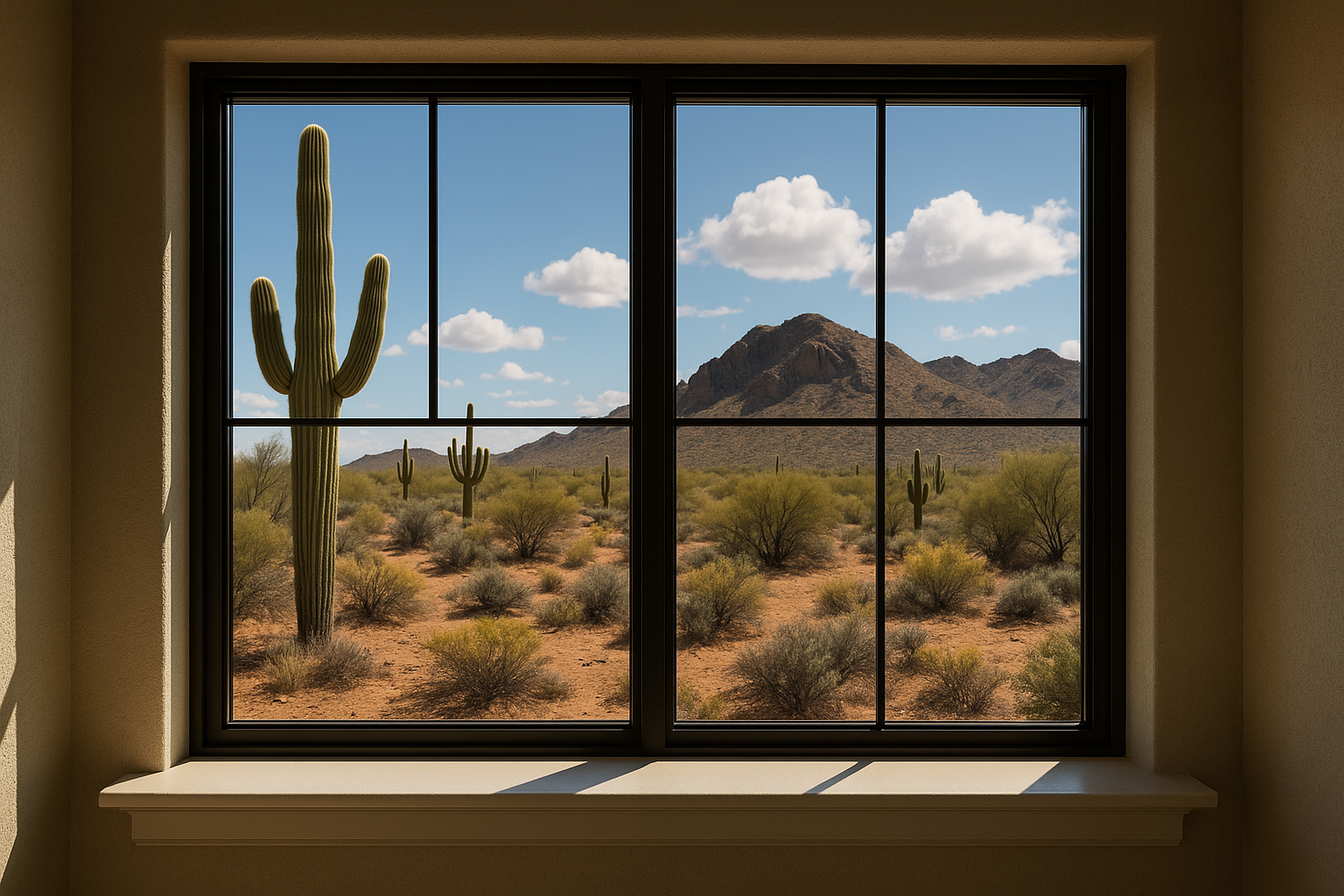
But beyond the math, there’s the comfort factor. You shouldn’t have to close the blinds and live in a cave just to keep the house cool. You should be able to enjoy the view of the desert landscape without feeling the burn.
Plus, new windows boost curb appeal instantly. It’s one of those upgrades that makes the house look ten years younger overnight.
Ready to Cool Down?
Choosing the right windows for Maricopa County isn’t just about picking a style you like; it’s about engineering your home to handle the desert. You need the right glass, the right frames, and an installation that holds up against the elements.
At Arizona Window Company, we don’t just sell windows; we help you protect your home comfort. We know the climate because we live here, too.
Why not see what a difference the right windows can make?
Give us a call at 480-526-4456
or Request a Free Quote
Let’s get your home ready for whatever the weather throws at it.