
There is a very specific, heart-stopping sound that happens when a sheet of glass slips through sweaty fingers and shatters on a concrete patio. It’s not just the noise; it’s the immediate realization that a Saturday afternoon project just turned into a hazardous cleanup mission. Honestly, we’ve all been there—trying to save a few bucks by doing it ourselves, only to realize that handling glass is a lot trickier than the YouTube tutorials let on.
Contents
First Things First: Respect the Invisible Knife
You know what? It’s easy to forget that glass is essentially a solid liquid that wants to be sharp. When it’s sitting in a frame, looking all transparent and innocent, it seems manageable. But the moment you take a sash out or try to wrestle a raw pane of double-strength glass, the dynamics change.
In Maricopa County, where the sun beats down on us pretty much year-round, we see a lot of DIY enthusiasm. And I love that energy. But here’s the thing: glass doesn’t care about your enthusiasm. It respects physics.
Before you even touch a pane, you have to get your head right. You aren’t just moving a piece of wood or a sheet of drywall. You are handling a material that has zero flexibility (unless it’s tempered, and even then, barely) and a high potential for injury. If you treat it like a loaded weapon, you’re probably in the right headspace.
The “Garden Glove” Mistake
I can’t tell you how many times I’ve walked up to a job site or a neighbor’s garage and seen someone handling jagged glass shards wearing those flimsy, yellow cotton garden gloves. You know the ones I mean. They’re great for pulling weeds, but against a glass edge? They might as well be made of tissue paper.
If you are going to swap out a broken window pane yourself, your hands need real armor.
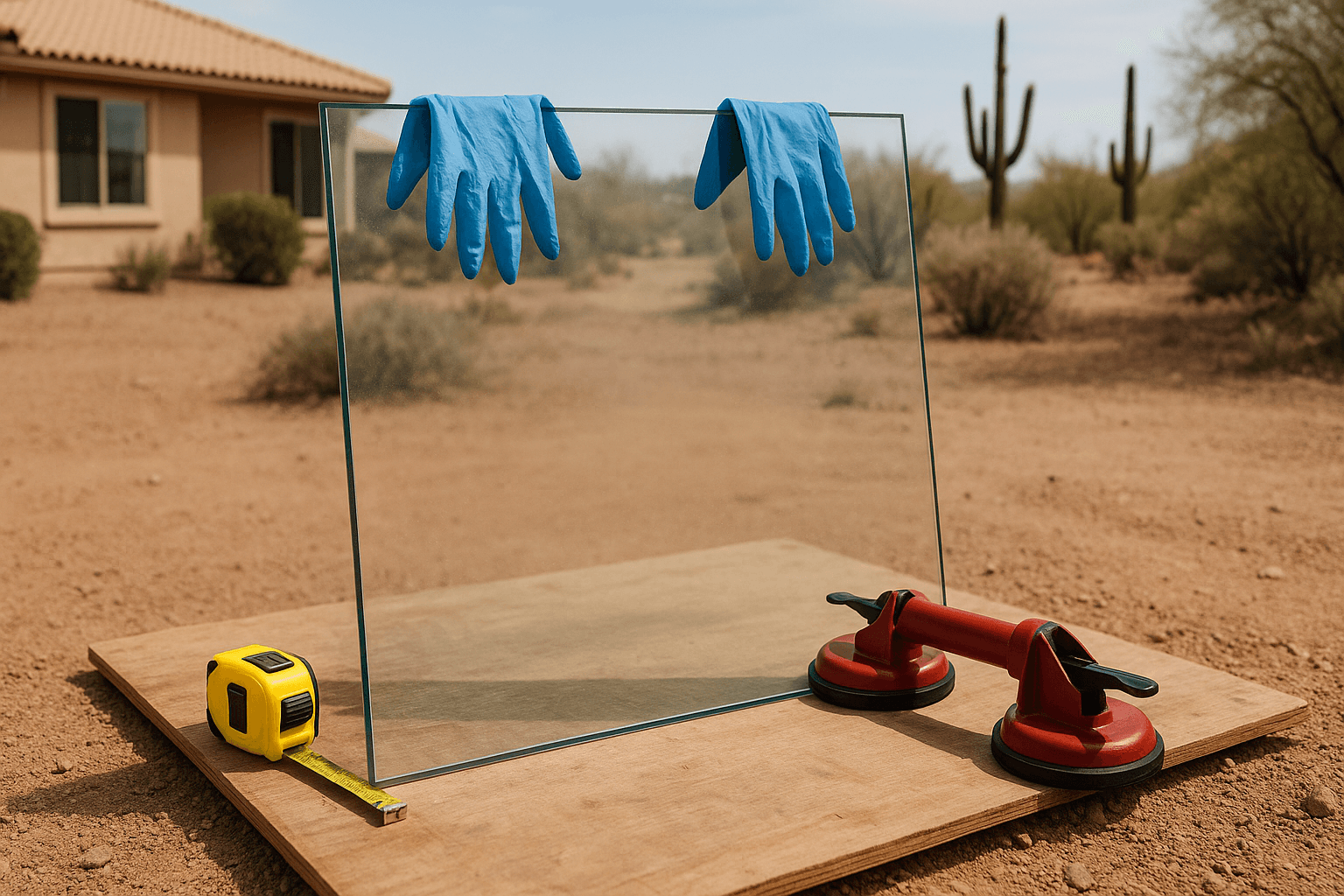
We aren’t talking about standard leather work gloves, although those are better than nothing. You really want gloves with a high ANSI cut rating. Professional glaziers—the folks who do this day in and day out—often wear gloves coated in Kevlar or nitrile foam. They offer grip and slice protection.
A Quick Gear Checklist
Let’s look at what you actually need versus what you think you might need.
| Essential Gear | Why You Need It | The “Bad Idea” Alternative |
|---|---|---|
| ANSI Cut-Resistant Gloves | Stops razor-sharp edges from reaching skin. | Cotton gardening gloves or bare hands. |
| Suction Cups (Glass Grips) | gives you a handle where there isn’t one. | Trying to pinch the glass with your fingertips. |
| Closed-Toe Boots | Falling glass cuts through sneakers easily. | Flip-flops (I know it’s hot in AZ, but don’t do it). |
| Safety Glasses (Z87+) | Glass chips fly faster than you can blink. | Squinting really hard. |
| Long Sleeves | Protects your forearms from accidental grazes. | Tank tops (Again, I know it’s hot, but safety first). |
The Mechanics of the Lift
Okay, so you’re geared up. You look like you’re ready to dismantle a bomb, which is good. Now, let’s talk about the physical act of moving the glass.
Here is where physics bites people. Glass is dense. A small pane might not feel heavy, but a double-pane insulated glass unit (IGU) can be surprisingly heavy and awkward. The center of gravity is weird, and because it’s transparent, your brain sometimes misjudges the distance to the edge.
Never carry glass flat.
This is the golden rule. If you carry a pane of glass flat like a pizza box, you are putting massive stress on the center of the sheet. Gravity pulls the middle down while your hands hold the edges up. Snap. It breaks right in your hands.
Instead, always carry glass vertically, on its edge. This puts the glass in compression, which is where it’s strongest. Keep it close to your body—almost hugging it, but not quite—and use your legs to move. It’s like dancing, but with higher stakes.
The Arizona Factor: Heat and Sweat
We have to address the elephant in the room: the Maricopa County heat.
If you are replacing a window in July, or honestly even in October, you are going to be sweating. Sweat and smooth glass are a terrible combination. It creates a lubrication layer that makes gripping the surface almost impossible without the right tools.
This is where those suction cups I mentioned in the table come into play. They aren’t just for pros. You can buy a decent pair at the local hardware store for twenty bucks. They create a vacuum seal on the glass, giving you a solid handle. It takes the grip strength variable out of the equation.
Also, consider the temperature of the glass itself. If a pane has been sitting in the direct Phx sun, it can literally burn you. Or, if you bring a freezing cold pane out of an air-conditioned house into 110-degree heat, the thermal shock could cause a stress crack if the glass has a nick in the edge. Let the glass acclimate in the shade for a bit if you can.
Dealing with the Broken Stuff
Sometimes, the replacement project is happening because the glass is already broken. Handling intact glass is one thing; handling a spider-webbed mess is another beast entirely.
If you have a shattered window that is still hanging in the frame, don’t just start yanking pieces out.
Tape it up first.
Use heavy-duty masking tape or duct tape. Run strips across the crack and the surrounding area. Ideally, you want to create a “film” that holds the shards together so they come out as one piece rather than raining down like jagged confetti.
When you do pull the pieces out, have a plan for where they are going immediately. Do not—I repeat, do not—drop them into a plastic trash bag. They will slice right through the side and get you in the shin when you carry the bag to the curb.
The Box Method:
- Get a sturdy cardboard box.
- Put the broken glass inside.
- Tape the box shut.
- Write “BROKEN GLASS” on the box in big, scary letters.
This isn’t just for you; it’s for the sanitation workers who have to handle your trash later. It’s just good karma.
The “Oops” Moment and Cleanup
Let’s say the worst happens. A pane slips, hits the corner of a step, and explodes.
First, freeze. Don’t instinctively reach out to catch falling glass—that is how tendons get severed. Let it fall. A broken window is cheaper than hand surgery.
Once the noise stops, clear the area of kids and pets immediately. Then, get the big pieces up with your gloved hands. For the tiny shards? A broom often misses the microscopic slivers that love to find bare feet three weeks later.
Pro Tip: Use a slice of soft white bread (yes, really) or a loop of duct tape to dab the floor where the glass shattered. It picks up the invisible dust-like shards that a vacuum might blow back out into the air.
Knowing When to Fold ‘Em
Look, I’m a huge fan of DIY. There is something deeply satisfying about fixing your own home. But there is also wisdom in knowing when a job is out of your league.
If you are dealing with:
- Large picture windows (anything wider than your arm span).
- Second-story glass (ladders and glass are a terrified mix).
- Tempered glass doors (heavy and prone to exploding if tapped on the edge).
- Rotten wood frames that are falling apart.
…it might be time to call in the cavalry.
Glass Replacement isn’t just about the glass; it’s about the glazing bead, the waterproofing, the shims, and ensuring the sash is square so the window actually opens and closes when you’re done. Sometimes, the frustration and the risk just aren’t worth the Saturday afternoon struggle.
Let Us Handle the Heavy Lifting
If reading about cut-resistant gloves and thermal stress fractures has you second-guessing your weekend plans, that’s totally fair. At Arizona Window Company, we handle glass all day, every day. We have the suction cups, the safety gear, and the experience to swap out your windows without a single shard hitting your patio.
Why risk a trip to the E.R. when you can have a perfect install with zero stress?
Give us a shout. We’re local, we know the Arizona climate, and we’re happy to help you get your home looking perfect again.
Ready to get started?
→ Call us directly at 480-526-4456
→ or [Request a Free Quote Here]