Living in the Valley, we have a complicated relationship with the sun—we crave that natural light, but we definitely don’t want the neighbors looking right into our living rooms while we’re enjoying our morning coffee. It’s a tricky balance, trying to keep your home bright and airy without feeling like you’re on display for the whole subdivision. You want the glow, but you also want your sanctuary.
Contents
- 1 The “Fishbowl” Effect in Maricopa County
- 2 Let’s Talk About Glass Textures (It’s Not Just for Bathrooms)
- 3 Strategic Placement: Clerestory Windows and Transoms
- 4 The Magic of Internal Blinds
- 5 Tinting and Reflective Coatings
- 6 Mixing and Matching for Real Life
- 7 Don’t Forget the Outside
- 8 Finding Your Balance
The “Fishbowl” Effect in Maricopa County
Let’s be real for a second. If you live in one of the newer developments around Chandler, Gilbert, or even parts of Phoenix, you know exactly what I’m talking about. The houses are beautiful, but they can be pretty close together. Sometimes it feels like you can reach out your kitchen window and high-five your neighbor.
This creates what I like to call the “Cave Paradox.” We buy these homes with massive windows because we want that open, desert-modern feel. We want to see the sky. But then, about a week after moving in, we realize privacy is an issue. So, what do we do? We shut the blinds. We close the heavy drapes. And suddenly, we’re living in a dark cave in the middle of the sunniest state in the country.
It doesn’t make much sense, does it?
You shouldn’t have to choose between feeling secure and getting your daily dose of Vitamin D. The good news is that window technology has changed a lot in the last decade. It’s not just about clear glass versus a solid wall anymore. There are nuances now—ways to trick the eye and the light.
Let’s Talk About Glass Textures (It’s Not Just for Bathrooms)
When most people think of privacy glass, their minds go straight to those old, frosted bathroom windows from the 90s. You know the ones. But honestly, textured glass—industry folks often call it “obscure glass”—has become a serious design element. It’s sophisticated now.
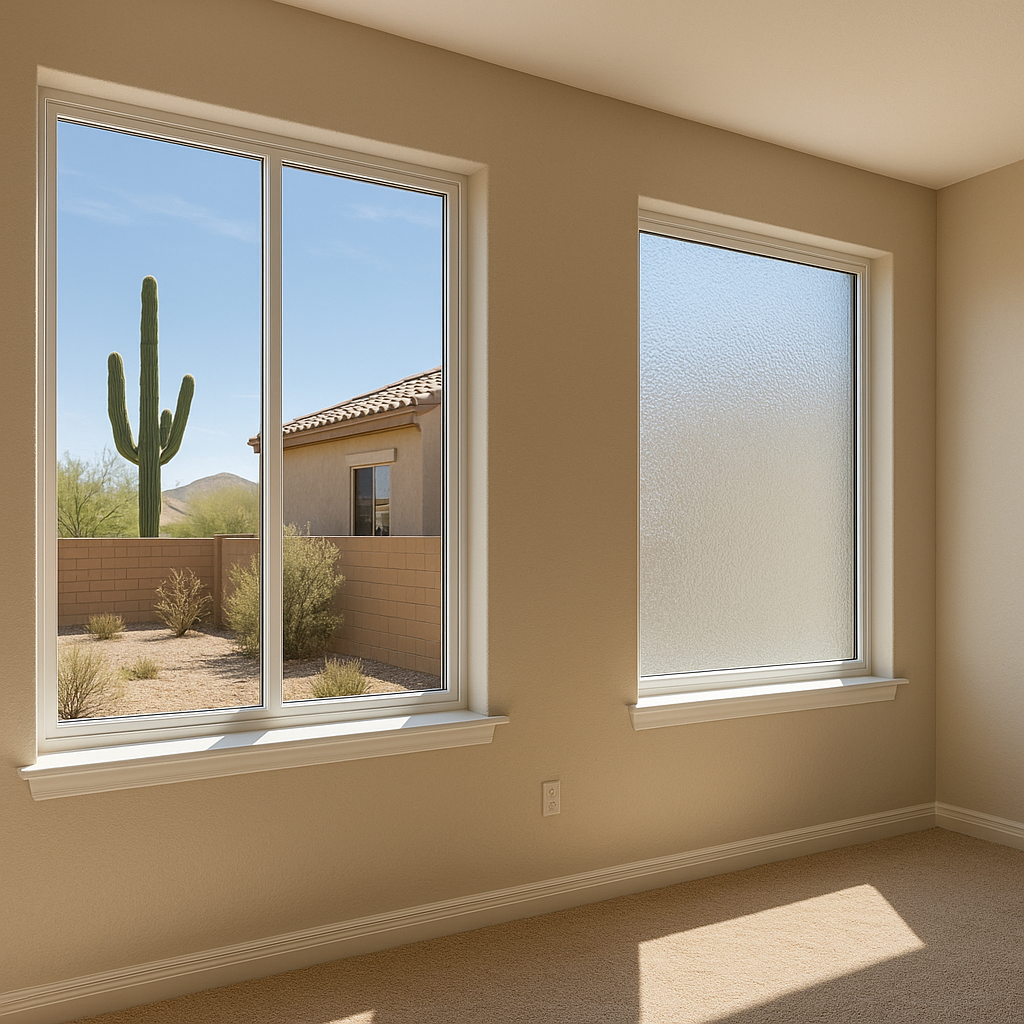
Using textured glass in strategic spots allows light to pour in while scrambling the view. You get the brightness, but if someone walks by, they just see a blur of movement, not the details of your life.
Here are a few popular options we see homeowners loving right now:
- Rain Glass: This looks exactly like water trickling down a pane. It’s incredibly elegant and works well with modern or Tuscan styles (which we have plenty of in Arizona). It distorts the view heavily but lets almost all the light through.
- Reed Glass: This features vertical lines or “reeds.” It has a bit of a retro, mid-century modern vibe. It’s great for entryways or sidelights next to your front door.
- Satin Etch: This is your classic “frosted” look, but smoother. It provides high privacy. The downside? It cuts a little more light than the others, but it gives a soft, glowing effect that is actually really calming.
Here’s the thing: You don’t have to do this on every window. That would look weird. But think about your entryway, your bathroom (obviously), or maybe that one side window that faces the neighbor’s brick wall. Why do you need a clear view of a brick wall? Swap that for Rain glass, and suddenly you have a bright, textured feature instead of an awkward view.
Strategic Placement: Clerestory Windows and Transoms
Okay, those words sound a bit technical, so let me break them down. This is less about the glass and more about where the window goes.
If you are remodeling or building an addition, or even just replacing windows and willing to do some framing work, you have to look at Clerestory windows. These are the wide, short windows placed high up on a wall, usually near the roofline.
Why are they amazing?
- Nobody can see in. Unless your neighbor is on a ladder, your privacy is 100% guaranteed.
- Wall space. Since the windows are high, you have free wall space below for artwork, TVs, or furniture.
- Daylight penetration. Light entering from high up reaches further into the room than light from a standard window.
Similar to this are Transoms. These are the smaller windows that sit above a door or a larger window.
I walked into a home in Scottsdale recently where they had replaced a standard sliding glass door with a slightly shorter door topped with a massive transom window. They could keep the curtains closed on the door for privacy, but that top window stayed uncovered, flooding the kitchen with natural light. It was a simple switch, but it changed the whole feel of the room.
The Magic of Internal Blinds
Sometimes, the best solution is the one that requires the least amount of cleaning. If you’ve lived in Arizona through a single monsoon season, you know about the dust. It gets everywhere. It settles on your blinds, and cleaning individual slats is nobody’s idea of a good time.
Enter: Blinds-between-the-glass.
This is exactly what it sounds like. The blinds are sandwiched between the two (or three) panes of glass in your insulated window unit.
- Privacy on demand: You can tilt them open to let light in or shut them tight for total privacy.
- Zero maintenance: They never get dusty. Ever.
- Safety: No dangling cords for pets or kids to get tangled in.
For a lot of people, this is the perfect middle ground. You get the option of a clear view when you want it, and privacy when you need it, without the clutter of external window treatments. It keeps the lines of the window clean and modern.
Tinting and Reflective Coatings
Now, we have to talk about heat. In Maricopa County, discussing windows without mentioning heat rejection is like talking about a car without mentioning the engine.
You might think that dark tint is the only way to get privacy. And sure, a dark tint works during the day. It acts like a mirror; people outside see their reflection, and you see out. But there’s a catch—and it’s a big one.
The Reverse Fishbowl Effect.
At night, when it’s dark outside and you have your lights on inside, that reflective effect flips. Suddenly, the neighbors can see right in, and your windows look like black mirrors to you. You can’t see out.
So, while reflective coatings are great for heat control (lowering that Solar Heat Gain Coefficient we worry about), don’t rely on them as your only source of privacy if you plan on having lights on at night.
However, a subtle, high-performance Low-E coating is essential. While it’s not primarily for privacy, it blocks UV rays that fade your furniture and keeps the radiant heat out. When you combine a high-quality Low-E glass with a texture (like the Rain glass we talked about), you get the trifecta: Light, Privacy, and Energy Efficiency.
Mixing and Matching for Real Life
You know what? It’s okay to mix these strategies. In fact, the best homes usually do.
I recently helped a homeowner in Mesa who was struggling with a front-facing living room. They felt exposed to the street. Here is what we did:
- We replaced the bottom half of their large picture window with tempered, reed-textured glass.
- We kept the top half clear.
The result? They could sit on their couch and read without feeling like pedestrians were watching them, but they could still see the sky and the tops of the trees through the upper clear glass. It was a custom solution, but it solved the problem without making the room feel closed off.
It’s about looking at how you actually live in the room.
- Bedroom: You probably want room-darkening shades or internal blinds.
- Bathroom: High obscurity texture is a must.
- Living Room: Maybe just the lower sashes need privacy, or maybe you use landscape placement (like planting a mesquite tree strategically) combined with clear glass.
Don’t Forget the Outside
Speaking of landscaping, sometimes the answer isn’t the window itself—it’s what is in front of it. We call this “biological privacy.”
In Arizona, we have great options for screening plants that don’t block all the light. A well-placed Ocotillo or a trellis with Cats Claw vine can break up the sightline from the street. This allows you to keep your windows relatively clear. The dappled light coming through a tree is often much nicer than the harsh direct sun anyway.
It allows you to keep the glass clear, maintaining that connection to the outdoors, while creating a buffer zone. It adds depth to your view, rather than just a flat wall of blinds.
Finding Your Balance
At the end of the day, your home is your castle. (Or your stucco fortress, depending on how you look at it). You shouldn’t have to sacrifice the beauty of natural light just to feel secure. Whether it’s swapping out clear glass for a cool texture, upgrading to internal blinds, or rethinking the window placement entirely, there is a solution that fits your lifestyle.
It’s not just about glass; it’s about how you feel when you walk into a room. Does it feel open? Does it feel safe? Getting that balance right changes everything.
If you are tired of living in the dark just to keep your privacy, maybe it’s time to look at some new options. We’ve seen every type of home layout Maricopa County has to offer, and we know how to handle the sun.
Let’s get some light back into your life.
Give us a ring at 480-526-4456 to chat about your options.
Or, if you prefer, you can Request a Free Quote online and we’ll come out to take a look.