Building a custom home is a whirlwind of decisions, from picking the perfect backsplash tile to figuring out exactly where the electrical outlets should go. It’s exciting, sure, but it can also feel a little overwhelming when you realize just how many choices you actually have to make. One of the most critical decisions—and honestly, one that often gets glossed over until the last minute—is choosing the right window frames.
Contents
- 1 Wait, Do Frames Really Matter That Much?
- 2 The Material World: What Actually Works in the Desert?
- 3 Let’s Talk Style: Framing Your View
- 4 Energy Efficiency: Or, How to Keep Your Electric Bill From Exploding
- 5 The “I Don’t Want to Clean This” Factor
- 6 Making the Connection: It’s About How You Feel
- 7 Ready to Frame Your Perfect View?
Wait, Do Frames Really Matter That Much?
You might be thinking, “It’s just the edge of the glass, right?” Well, yes and no. While the glass does the heavy lifting when it comes to the view, the frame is the unsung hero that holds everything together. It’s the skeleton.
Think of it like a picture frame in an art Gallery. A bad frame can distract from a masterpiece, while the right one enhances it so naturally you barely notice it’s there. In Maricopa County, where we have some of the most stunning desert sunsets in the world, you want frames that highlight that beauty, not fight against it.
But here’s the thing: in Arizona, it’s not just about looks. It’s about survival.
We aren’t building homes in cloudy Seattle or mild San Diego. We are building in the Sonoran Desert. Our homes have to withstand 115-degree days, monsoon microbursts, and UV radiation that can bleach a patio cushion in a single summer. The wrong window frame can warp, crack, or fade faster than you’d believe. So, picking the right one is about protecting your investment.
The Material World: What Actually Works in the Desert?
When you start looking at brochures or browsing Pinterest, you’ll see a lot of options. Wood, vinyl, aluminum, fiberglass, composite. It’s a lot. But let’s narrow this down to what actually makes sense for us here in the Valley.
1. Vinyl: The Popular Contender
Vinyl has come a long way since the cheap, yellowing plastic frames of the 80s. High-quality vinyl is now one of the most common choices for new builds, and for good reason. It’s affordable and surprisingly energy efficient because plastic doesn’t conduct heat well (which is a good thing when it’s frying outside).
However, you have to be careful. In our extreme heat, low-grade vinyl can sometimes warp or become brittle over time. If you go this route, you want high-quality, UV-stabilized vinyl.
- Pros: Cost-effective, good insulation, low maintenance.
- Cons: Can look a bit “chunky,” limited color options (though this is changing), sensitive to extreme heat if low quality.
2. Aluminum: The Modernist’s Dream
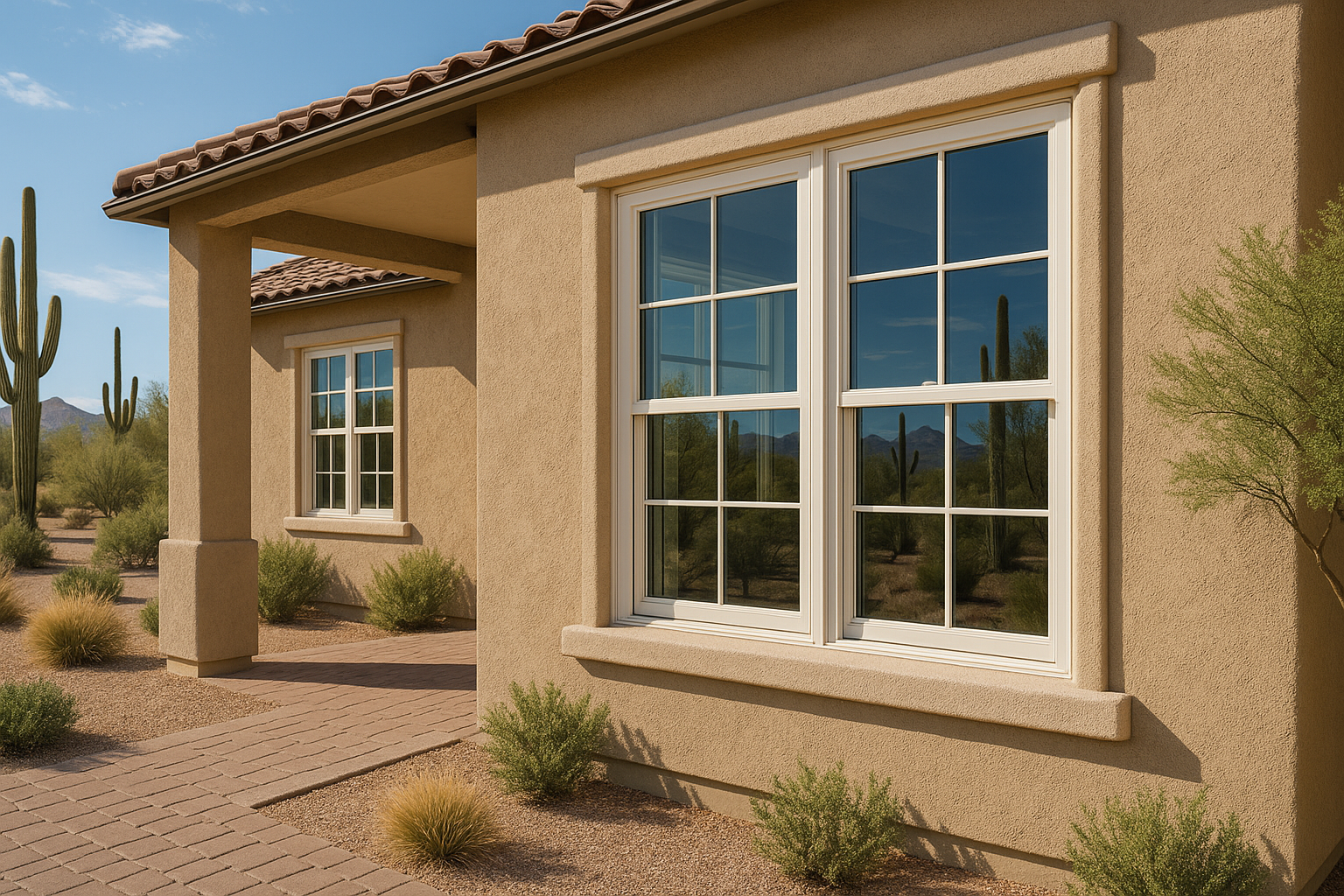
If you drive around some of the newer, sleeker neighborhoods in Scottsdale or Paradise Valley, you’ll see a lot of aluminum. Architects love it because it’s incredibly strong. Because it’s so strong, the frames can be very thin, giving you more glass and less visual clutter.
But wait—metal conducts heat, right? You might be wondering if aluminum frames will turn your living room into an oven.
Standard aluminum would. But here, we use “thermally broken” aluminum. This means there is a barrier between the inside metal and the outside metal so the heat doesn’t transfer through. It’s a game-changer.
- Pros: sleek aesthetic, incredibly strong, distinct “modern” look, recyclable.
- Cons: Can be pricier than vinyl, requires thermal breaks to be efficient in AZ.
3. Fiberglass: The Tough Guy
Honestly, fiberglass is like the superhero of window frames. It’s made from glass fibers (just like the window pane itself), so the frame and the glass expand and contract at the same rate when the temperature changes. This is huge in Arizona where the temp can drop 30 degrees at night and spike the next day. This stability protects the seal of the window.
- Pros: extremely durable, paintable, energy-efficient, resists warping.
- Cons: Usually more expensive than vinyl, fewer style options than wood.
4. Wood: The Classic (With a Catch)
Wood is beautiful. There is no denying the warmth and character it adds to a Spanish Colonial or a ranch-style home. But in Phoenix? Wood is high maintenance. The sun beats it up, and termites love it. If you absolutely love the look, consider “clad” wood—where the outside is wrapped in aluminum or vinyl for protection, but you still see the wood on the inside.
Let’s Talk Style: Framing Your View
Once you settle on the material, you get to have some fun with the design. This is where your home’s personality really shines through. The frame isn’t just a border; it’s an architectural element.
Color Trends
For a long time, white was the default. It’s clean, it reflects heat, and it matches everything. But lately? Black frames are everywhere.
You’ve probably seen them on those modern farmhouse builds. Black frames create a high contrast that makes the windows pop. They frame the desert landscape like a photograph. If you are worried about black frames absorbing heat, don’t panic—modern frame materials are designed to handle it, though they might retain a bit more warmth than white ones.
Bronze and anodized silver are also huge right now, especially for homes aiming for that “desert modern” vibe. They blend beautifully with the dusty browns, greens, and terracottas of our natural landscape.
Frame Thickness
This is a subtle detail that changes the whole feel of a room.
- Thick Frames: These make a statement. They feel substantial and traditional. If you are building a Tuscan or Santa Barbara style home, a thicker frame with some architectural detail looks right at home.
- Thin Frames: These disappear. If you have a killer view of Camelback Mountain or the Superstitions, you probably want thin frames (usually aluminum or fiberglass) so nothing blocks your sightline.
Energy Efficiency: Or, How to Keep Your Electric Bill From Exploding
We can’t talk about windows in Maricopa County without talking about insulation. It’s not the most glamorous part of building a house, but your wallet will thank you later.
When we talk about frames, we aren’t just looking at the glass (which should be Low-E, by the way). The frame itself plays a massive role in the “U-Factor.”
Okay, sorry for the jargon. Let me explain. The U-Factor basically measures how well the window keeps heat from escaping or entering. In our climate, we also care deeply about the SHGC (Solar Heat Gain Coefficient), which measures how much solar radiation comes through.
A metal frame without a thermal break is like a highway for heat. It grabs the heat from outside and zooms it right into your air-conditioned living room. Vinyl and fiberglass act more like a roadblock. They don’t conduct heat well, which keeps the inside frame cool to the touch even when it’s blazing outside.
When you are picking frames, ask yourself: Is this going to help my AC unit, or fight against it?
The “I Don’t Want to Clean This” Factor
Let’s be real for a second. You are building a new house to enjoy it, not to spend every Saturday maintaining it.
Arizona is dusty. We have haboobs. We have pollen. Things get dirty fast.
- Vinyl: A quick wipe down with soap and water usually does the trick. It doesn’t need painting. Ever.
- Aluminum: Also very low maintenance. It doesn’t rust (it oxidizes slightly, which actually protects it), and it wipes clean easily.
- Wood: This is where the work comes in. If you have exposed wood exteriors, you will be sanding and restaining or repainting every few years. In our sun, paint peels faster than you’d expect.
If you are the type of person who loves DIY projects, wood might be fine. But if you’d rather spend your weekend by the pool or on the golf course, sticking with vinyl, fiberglass, or aluminum is usually the smarter play.
Making the Connection: It’s About How You Feel
Building a home is a long road. There are inspections, delays, and a million little headaches. But there is a moment—usually right after the windows go in—where the structure suddenly feels like a house. The wind stops blowing through the hallways. The noise from the street quiets down. You can see the view, but you feel safe and enclosed.
The frames you choose are the border between your sanctuary and the outside world. They set the tone for the light that fills your rooms. They are the first thing you look through in the morning to check the weather, and the last thing you close at night.
It’s easy to get caught up in the specs and the prices, and those things matter, absolutely. But don’t forget the artistry of it. Whether you go for the bold contrast of black aluminum or the soft, traditional look of white vinyl, make sure it’s something that makes you smile when you pull into the driveway.
Ready to Frame Your Perfect View?
Choosing the right windows for a new build isn’t something you should have to do alone. At Arizona Window Company, we have seen it all—from modern glass boxes in the hills to cozy family ranch homes in the suburbs. We know what materials hold up to the Phoenix sun, and we know how to match your style without blowing your budget.
You deserve a home that looks beautiful and stays cool. Let’s make that happen.
Give us a call today: 480-526-4456
Or click here to Request a Free Quote
Let’s get those views framed perfectly.