
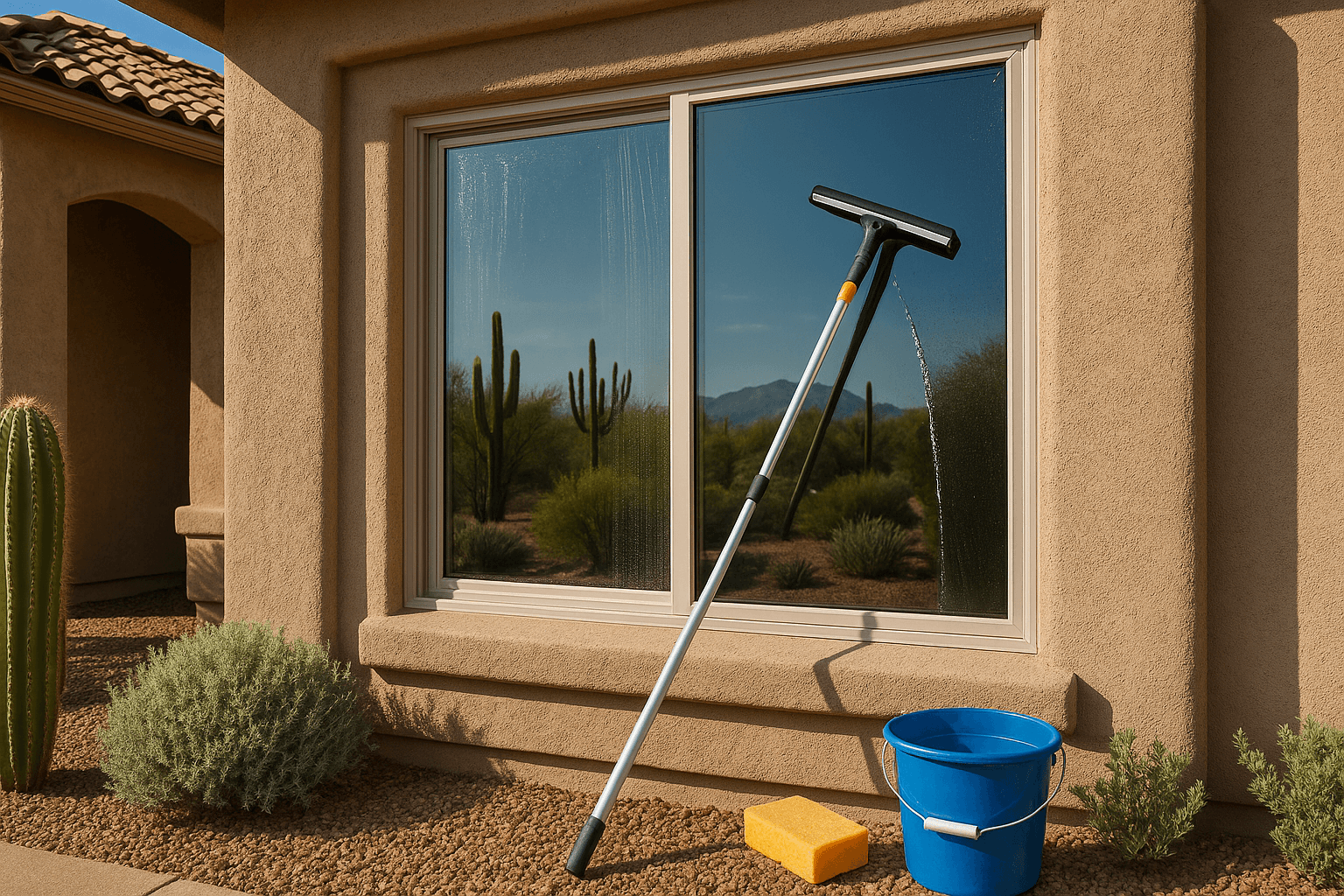
Living in the Valley means accepting that the sun isn’t just a weather feature; it’s a relentless force that your house battles every single day. Your windows are the frontline defense against those triple-digit temps, keeping your AC bill from spiraling into mortgage-payment territory. Neglecting them isn’t just an aesthetic issue—it’s an expensive mistake waiting to happen.
Contents
- 1 The “Dry Heat” is Tougher Than You Think
- 2 Cleaning: It’s Not Just About the View
- 3 Don’t Forget the Tracks (Yes, the Gross Part)
- 4 Monsoon Prep: Check Your Weep Holes
- 5 Screens: The Unsung Heroes
- 6 Glass Inspections and “Low-E” Care
- 7 When Is It Time to Throw in the Towel?
- 8 Let’s Keep the Heat Out Together
The “Dry Heat” is Tougher Than You Think
You know the saying, “It’s a dry heat”? Yeah, we say it to make ourselves feel better when it hits 115 degrees, but for your windows, that dry heat is actually brutal. The extreme temperature fluctuations we get in Maricopa County—searing hot days followed by somewhat cooler nights—cause materials to expand and contract constantly. It’s basic physics, but it’s a nightmare for window seals.
Honestly, think about your car dashboard. You wouldn’t leave it unprotected without expecting cracks, right? Your home windows deal with similar stress. Over time, this thermal pumping can cause the seal between the glass panes to fail. Once that seal goes, the insulating gas (usually argon) escapes, and suddenly your high-tech, energy-efficient window is just two pieces of glass holding hands.
Here’s what you need to watch for:
- Condensation between panes: If you can’t wipe the fog off because it’s inside the glass, the seal is broken.
- Drafts: If you walk by a closed window and feel a ghost of a breeze, your weatherstripping might be fried.
- Warped frames: Vinyl is great, but cheap vinyl can warp under the Arizona sun, breaking the airtight fit.
Cleaning: It’s Not Just About the View
Let’s be real for a second—cleaning windows is nobody’s idea of a fun Saturday morning. But here in the desert, dust is a different beast. We get those massive haboobs that roll through, coating everything in a fine layer of grit. If you let that dirt sit on the glass and frames, it can actually bake into the surface or etch the glass over time.
Plus, there’s the hard water issue. If your sprinklers are hitting your windows (which, let’s be honest, happens to the best of us), you’re going to get calcium deposits that are tougher to remove than a rusted bolt.
A few tips to save your sanity:
- Skip the direct sun: Never clean your windows when the sun is blasting directly on them. The cleaner will dry before you can wipe it off, leaving streaks that look worse than the dirt. Early mornings are your friend.
- The Vinegar trick: You don’t need fancy chemicals. A mix of 50/50 water and white vinegar cuts through most grime. It smells like a salad for five minutes, but it works.
- Squeegee life: Paper towels just push dirt around. Get a decent squeegee. It’s weirdly satisfying to use, too.
Don’t Forget the Tracks (Yes, the Gross Part)
Okay, this is the part everyone ignores. Open your sliding window or patio door and look down. It’s probably a graveyard of dead bugs, dust bunnies, and unidentifiable grit.
Why does this matter? Aside from being gross, that buildup ruins the rollers. It’s like trying to ride a skateboard through sand; eventually, the wheels stop turning and start dragging. If you find yourself having to use two hands and a grunt to close your sliding door, dirty tracks are usually the culprit.
Here is the lazy-proof way to handle it:
- Vacuum first: Don’t add water yet. Use the crevice tool on your vacuum to suck up the loose debris.
- Baking soda magic: Sprinkle a little baking soda in the track, specifically in the corners.
- Vinegar bath: Pour a tiny bit of vinegar on the baking soda. It’ll fizz up (science experiment style) and loosen the stuck-on gunk.
- Toothbrush scrub: Use an old toothbrush to scrub it out, then wipe clean with a rag.
It takes ten minutes, but your windows will slide like they’re on ice.
Monsoon Prep: Check Your Weep Holes
You might be asking, “What on earth is a weep hole?” Go outside and look at the bottom of your window frame. You should see little slits or holes. Those are designed to let water drain out of the track so it doesn’t spill over into your house.
During monsoon season, when the rain comes down sideways, these little guys are essential. But because they are small, they get clogged easily by that same desert dust and bug debris we talked about earlier.
If a weep hole is blocked, the water fills up the track like a bathtub. Eventually, it has nowhere to go but inside, ruining your drywall or flooring. It’s a small detail that causes massive headaches. Use a piece of wire or a toothpick to poke them clear before the storms roll in.
Screens: The Unsung Heroes
In Arizona, window screens aren’t just for bugs; they actually provide a tiny bit of shade, too. But the sun destroys the mesh material, making it brittle and grey.
If you poke your screen and your finger goes right through it, it’s time for a rescreen. It’s actually surprisingly easy to do yourself with a spline roller and some new mesh from the hardware store. But if the frame itself is bent—maybe from taking it down during a storm—it’s never going to sit right again.
Quick check for screens:
- Look for tears: Mosquitoes only need a tiny gap.
- Check the tabs: The little plastic pull-tabs usually snap off after a few years of UV exposure.
- Frame fit: If the screen rattles in the wind, the frame is likely bent or the clips are loose.
Glass Inspections and “Low-E” Care
Most modern windows in our area have Low-E (low emissivity) coatings. This is a microscopic layer of metal oxide that reflects heat. It’s invisible, but it’s the reason your couch doesn’t fade within a month.
Sometimes, people get aggressive with razor blades or abrasive pads trying to get paint overspray or bird droppings off the glass. If you scratch that coating or the glass surface, you create a weak point. Tempered glass, which is often used in sliding doors and windows near the floor, is strong but can be sensitive to scratches.
The Golden Rule: Never use a razor blade on dry glass. Always keep it wet and soapy if you absolutely have to scrape something off. Better yet, stick to non-abrasive scrubbers.
When Is It Time to Throw in the Towel?
Look, maintenance can only do so much. If your windows are single-pane aluminum sliders from the 80s, you are basically trying to cool the entire neighborhood. No amount of cleaning or caulking is going to fix the fact that heat is radiating through that glass like a space heater.
You might notice that even with the AC cranking, the rooms facing west are uninhabitable in the afternoon. That’s a hardware problem, not a maintenance problem. Sometimes, the most cost-effective maintenance you can do is realizing the old windows are costing you more in energy bills than they are worth.
Let’s Keep the Heat Out Together
Keeping your windows in top shape is really about protecting your sanctuary. It’s about being able to sit by the window in July without sweating, and watching the monsoon lightning without worrying about leaks. A little bit of elbow grease goes a long way.
However, if you’ve tried the cleaning, checked the tracks, and you’re still feeling the heat—or if you’re looking at fogged glass that just won’t clear up—it might be time for a professional opinion.
We know the Maricopa climate better than anyone because we live here, too. Whether you need a simple repair or you’re ready to upgrade to windows that can actually handle the Arizona sun, we’ve got your back.
Give us a call at 480-526-4456
Or click here to Request a Free Quote