Living in the Valley means we get abundant sunshine nearly every single day of the year, so it makes total sense to bring some of that gorgeous natural light inside your home. Honestly, installing a skylight can completely change how a dark hallway or a cramped kitchen feels, turning it from a gloomy cave into a bright, welcoming space. But before you start cutting holes in your roof, there are a few very specific things you need to know about making this project work for our unique desert climate.
Bringing the sunshine in (without roasting your living room)
You know what? I hear the exact same concern from almost every homeowner I talk to here in Maricopa County. They want natural light. They crave it. But they are absolutely terrified that putting a window on their roof will turn their house into a sweltering greenhouse.
It is a completely valid fear. Summer here is no joke, and your AC is already working overtime just to keep the house livable.
Actually, that brings up an interesting contradiction. We spend half the year hiding from the sun behind thick blackout curtains, yet we still want our homes to feel bright and airy. The good news is that modern skylight technology has evolved massively over the last decade. You really do not have to choose between a beautifully lit kitchen and a reasonable electric bill anymore. With the right glass, proper placement, and solid installation work, you get all the sunshine without the miserable heat transfer.
Fixed, vented, or a little tube? Choosing your style
When you begin looking at your options, you will quickly realize there is more than one way to get sunshine through a roof. Let me explain the three main paths you can take for your home.
- Fixed skylights: These are exactly what they sound like. They are completely sealed windows for your roof that do not open. If you just want light and a view of the stars, this is your go-to option.
- Vented skylights: These actually open up to let fresh air flow inside. Some are manual, operated by a long pole, while others are motorized and run by a remote control or even a smartphone app. They are absolutely fantastic for letting hot air escape during our cooler winter and spring months.
- Tubular skylights: Also known as sun tunnels. These are basically highly reflective metal tubes that capture light on the roof and funnel it down into a small, flat dome on your ceiling. They are perfect for small spaces like bathrooms, walk-in closets, or tight hallways where a full-sized window just will not fit.
Honestly, tubular skylights are wildly underrated. I installed one in a windowless laundry room a while back, and the homeowner kept trying to flip the light switch off because it was so shockingly bright during the day.
Wait, curb-mounted or deck-mounted?
Okay, we need to talk a little bit of shop here. If you are browsing through options from major brands like Velux, you are going to see the terms “curb-mounted” and “deck-mounted” everywhere. It sounds confusing, but it is actually pretty simple.
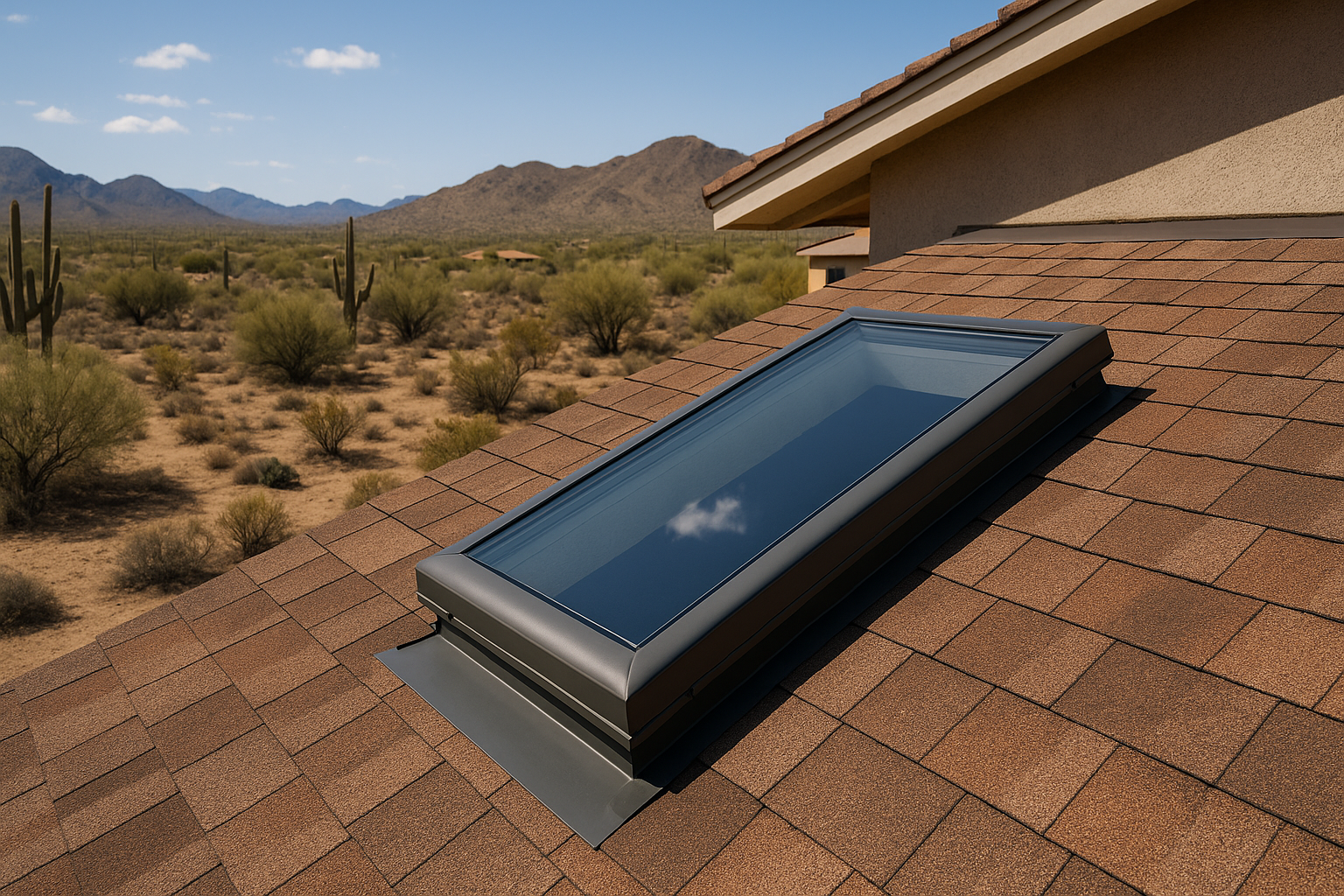
A curb-mounted skylight sits on a raised wooden frame—a curb—that we build directly on top of your roof deck. Think of it like putting a lid on a sturdy shoebox. This style is incredibly popular here in Arizona, especially on flat or low-slope roofs covered in foam or rolled roofing. Elevating the unit keeps the window safely away from sitting water during our sudden monsoon downpours.
A deck-mounted skylight, on the other hand, is nailed directly to your roof decking. It sits completely flush, giving it a much lower, sleeker profile from the street. This looks absolutely gorgeous on pitched shingle or concrete tile roofs. The flashing—the metal pieces that keep water out—weaves right into the roofing material for a seamless look.
Here’s the thing: The installation gets a little messy
Look, I want to be entirely straight with you. It sounds like a simple project. A quick cut, drop the window in, and you are done. Except, it is not simple at all. Putting in a new skylight is essentially a mini-remodel, and it requires construction inside your house, too.
First, we have to cut through your roof. That means dealing with heavy tiles or shingles, pulling back the underlayment, and sawing through the wood roof decking. Once the hole is cut, the actual window is secured and meticulously flashed. The flashing part is critical. Water always finds a way, and even though we live in a dry desert, those July microbursts dump a ridiculous amount of rain in a very short time. We use specialized step flashing and an adhesive ice-and-water shield to make sure your new window never, ever leaks.
Then comes the inside work. Unless you have an exposed beam ceiling, there is a dark attic space between your roof and your ceiling. We have to build a “shaft” or “chase” through that attic space to funnel the light down into the room. This means framing with wood studs, hanging drywall, taping the seams, mudding, and finally painting.
And yes, drywall work creates fine, white dust. We tarp everything off and do our absolute best to contain it, but you should expect a little bit of a mess for a few days. It gets messy. Truly, it gets a little messy. It is just the nature of the beast. But once that fresh paint dries and the sun pours in? It is totally worth it.
Glass tech: Keeping the heat outside where it belongs
Let’s circle back to that greenhouse fear. If you threw a piece of cheap, single-pane glass on your roof, you would absolutely bake. Your floors would fade, and you would be miserable. But we do not do that.
Modern residential skylights use highly advanced, energy-efficient glass. You will hear the term Low-E, which stands for low-emissivity, tossed around a lot in this industry. Basically, Low-E glass has a microscopic, entirely invisible metallic coating baked right into it. This coating acts almost exactly like a strict bouncer at a nightclub. It lets the good stuff in (visible light) and aggressively kicks the bad stuff out (UV rays and infrared heat).
When you look at window specifications, pay attention to the SHGC, or Solar Heat Gain Coefficient. It is a number between 0 and 1. The lower the number, the less solar heat the glass transmits into your home. For Arizona homes, we want that number as low as possible. It is basically like putting SPF 50 on your living room. You get a gorgeously lit room without your furniture fading or your AC running non-stop.
Finding the absolute perfect spot
Where you place this window matters almost as much as the window itself. Roof orientation completely changes the quality and intensity of the light you receive.
If you put a skylight on a north-facing roof slope, you get cool, consistent, indirect sunlight all day long. It is beautiful, soft light. No harsh glare, just a gentle glow.
If you put it on a west-facing slope? Well, you are going to catch the full, blinding force of the late afternoon Phoenix sun. Sometimes that is exactly what a deeply shaded room needs, but you definitely have to pair it with a heavy tint or built-in solar blinds to control the extreme glare.
Here is a quick breakdown to help you visualize how different placements work:
| Roof Direction | Light Quality | Heat Potential in Summer | Ideal Room Types |
|---|---|---|---|
| North | Soft, consistent, cool | Very low | Bedrooms, home offices, art studios |
| South | Strong, warm, direct | Moderate to High | Kitchens, large living rooms |
| East | Bright morning light | Low to Moderate | Bathrooms, breakfast nooks |
| West | Intense late afternoon light | Extremely High | Rarely recommended without solar blinds |
Just remember, there is a right spot and a wrong spot for every house. Sometimes moving the window just two feet over makes all the difference in the world regarding how the light hits your kitchen island.
A quick word on haboobs and maintenance
We cannot talk about exterior home upgrades in Maricopa County without mentioning the dust. When a haboob rolls through the Valley, everything gets covered in a fine layer of brown dirt. Your roof is no exception, and neither are your new skylights.
Thankfully, high-quality models from companies like Velux often come with special glass coatings designed just for this. This is a special layer that makes the glass incredibly smooth, so water beads up and rolls off easily. When it finally rains after a dust storm, the glass practically washes itself. For the times it does not rain for months, a quick spray with a garden hose from the ground is usually all it takes to clear the dust away. No climbing on the roof required.
Ready to let the light in?
Adding natural light to your home changes the entire vibe of your living space. It makes rooms feel larger, cleaner, and far more welcoming. It is honestly one of the most rewarding exterior upgrades you can make to your property.
If you are tired of flipping on the overhead lights at two in the afternoon, we are here to help. At Arizona Window Company, we know exactly how to handle complex roof installations that stand up to the extreme Arizona climate. Let us help you find the perfect, energy-efficient way to brighten up your dark spaces.
Give us a call today at 480-526-4456 or Request a Free Quote to get your project started!