
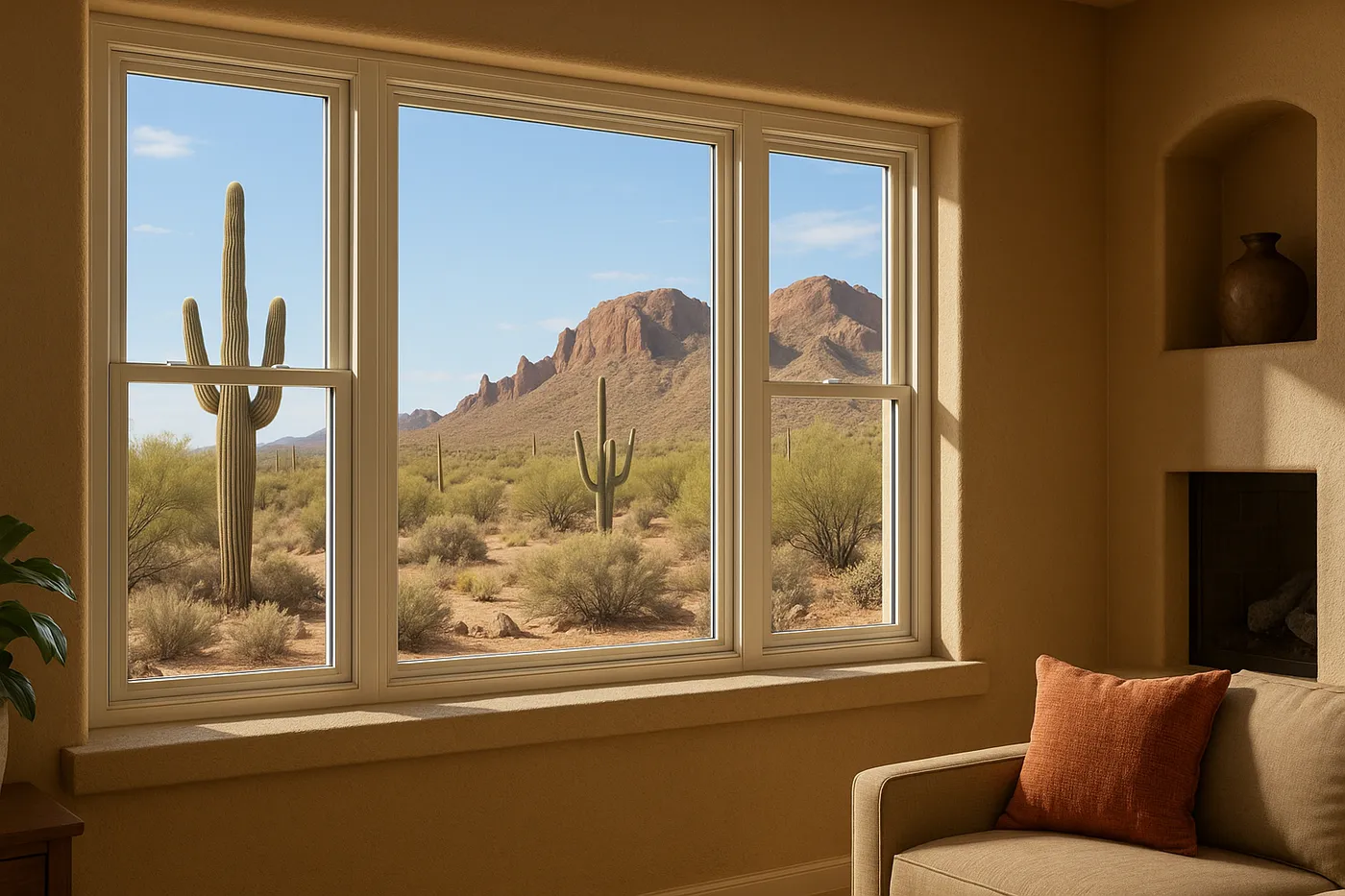
If you’ve survived a summer in Maricopa County, you know our sun doesn’t just shine—it absolutely bakes everything it touches. Honestly, trying to keep your living room cool in July with builder-grade single-pane glass is like trying to hold back the ocean with a teaspoon. You just end up watching your electric bill skyrocket while your central AC unit screams for mercy.
The Invisible Money Leak in Your Living Room
Let’s get right to it. The windows in your house are probably bleeding money. You know what? A lot of folks don’t realize just how much heat transfers right through standard glass. We talk a whole lot about putting better insulation up in the attic, but your windows are literally giant, transparent holes in your walls.
When that brutal afternoon sun hits the west side of your house, it turns your front room into a literal oven. Your thermostat clicks on, your AC works overtime, and your local power company sends you a bill that makes you want to cry. Heat transfer. It’s all about heat transfer. Stop the heat transfer, and you solve the comfort problem.
You see, standard builder-grade glass offers virtually zero resistance to the Arizona sun. It lets the radiant heat pour right into your home. And this doesn’t just make you sweat. That same ultraviolet light fades your expensive living room couch, ruins your hardwood floors, and makes your window treatments brittle over time.
What Actually Makes a Window Energy Efficient?
Here’s the thing. Not all glass is created equal. If you wander down the aisles of a big box hardware store, you’ll see a million different labels making a million different promises. Let me explain what actually matters for homes in our specific desert climate.
You might think installing heavy triple-pane glass is the ultimate solution for Phoenix heat. It makes perfect sense, right? More glass equals more protection. But honestly, triple-pane is often overkill here. The real magic isn’t in the raw thickness of the glass, but in the invisible technology applied to it.
- Low-E Glass (Low-Emissivity): This right here is the holy grail for desert living. Basically, manufacturers apply a microscopically thin metallic coating directly onto the glass. It reflects the sun’s heat back outside where it belongs, while still letting the visible sunlight sneak through. Your house stays bright, but you won’t sweat while eating dinner.
- Argon Gas Fills: Most modern energy-efficient setups use two panes of glass. But the space between them isn’t just empty air. They pump in a harmless, invisible gas—usually Argon. Why? Because Argon is significantly denser than regular air. It acts like an invisible thermal blanket, severely slowing down the heat trying to cross from the outside in.
- Warm-Edge Spacers: This is a bit of a nerdy work term, but spacers are the structural pieces that separate the panes of glass. Cheap metal spacers get extremely hot. Warm-edge spacers are made of non-conductive materials, which keeps the very edges of your glass from heating up and ruining the whole system.
The Frame Game: Materials That Survive the Desert
You can have the absolute best, highly engineered glass in the universe, but if the frame wrapping it is terrible, you’re still going to roast. The frame material matters just as much as the glass itself.
Honestly, a huge number of older homes around the Valley still have those thin, silver aluminum frames. They conduct heat like a cast-iron frying pan. Touch one of those frames at 3 PM in August, and you might actually burn your finger.
Let’s look at how the most common frame materials stack up against our local weather conditions.
Most homeowners around here choose high-quality vinyl or fiberglass. Good vinyl resists the harsh UV rays we get year-round, and it simply doesn’t transfer heat from the outside to the inside. Plus, it won’t warp, swell, or rot when the monsoon humidity briefly spikes late in the summer. It’s tough, reliable, and requires basically no maintenance.
Decoding the Alphabet Soup: U-Factor and SHGC
If you’ve started shopping around or doing some late-night online research, you’ve probably seen some strange acronyms on window energy stickers. It feels a bit like reading a foreign language. Let’s break down the two most critical numbers you actually need to care about.
- U-Factor: This rating measures how well a window stops non-solar heat from escaping or entering your home. Think of it like the rating on a good thermos. The lower the number, the better the glass insulates. For Maricopa County, you generally want to see a U-Factor of 0.30 or less.
- SHGC (Solar Heat Gain Coefficient): This is the big one for Arizona. SHGC specifically measures how much solar radiation comes right through the glass. Think of it like wearing a white t-shirt versus a black t-shirt in the sun. A lower number means significantly less heat makes it inside. We usually recommend an SHGC of 0.25 or lower to properly combat our brutal summers.
It’s easy to get lost in the weeds with these metrics, but just remember: lower numbers are your best friend. When you lower the SHGC, you immediately lower the temperature inside your house.
Beyond the Electric Bill: Noise, Dust, and HVAC Lifespans
Putting off major home repairs is basically a national pastime. I completely get it. It’s a big decision. But ignoring drafty, inefficient windows is a choice you pay for every single month, over and over again.
Think about your poor HVAC system. When your home constantly leaks cool air out and lets radiant heat in, your AC cycle runs way longer than it should. That constant, grinding strain takes years off the lifespan of a system that costs thousands and thousands of dollars to replace. So, you’re not just paying higher utility bills right now; you’re actively wearing out your air conditioner for the future.
And then there’s a pleasant surprise most people don’t anticipate: the quiet. This is a natural tangent, but it’s an important one. Because energy-efficient windows use thicker glass, heavy gas fills, and tighter seals, they naturally block out a massive amount of exterior noise.
If you live anywhere near the 101, the I-10, or just a busy neighborhood street, the sudden drop in traffic noise is startling in the best way possible. You get to enjoy your morning coffee without hearing every single garbage truck and landscaping crew on the block. Furthermore, those tight seals block out the fine desert dust that constantly blows around during our summer haboobs. Less dusting, less noise, more comfort.
Let’s Stop Air Conditioning the Neighborhood
Upgrading to energy-efficient windows isn’t just some casual vanity project to make your house look pretty from the street. Though, they definitely do add some serious curb appeal. It’s a real, tangible investment in your home’s everyday comfort, your personal sanity during the summer months, and your long-term monthly budget.
When you work with Arizona Window Company, we don’t just hand you a piece of glass and wish you luck. We make absolutely sure the installation is flawless. You can buy the most expensive, highly-rated window on the market, but if it’s installed poorly, it will leak air just as badly as the old one. Our installation crews know exactly how to seal everything up tight against our unique desert elements.
So, are you ready to finally stop paying to air-condition the entire neighborhood? Let us help you find the absolute perfect fit for your home. You can easily reach out by phone at 480-526-4456 to chat directly with our local team, or simply Request a Free Quote through our website. Let’s get your house cool, quiet, and comfortable again.